

Apollo Meets Soyuz: Space Rivals Dock in Orbit
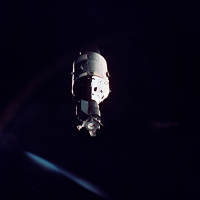
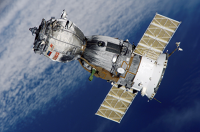
American and Soviet spacecraft linked together 140 miles above the Earth on July 17, 1975, and the two commanders shook hands through an open hatch while their countries' nuclear arsenals remained pointed at each other below. The Apollo-Soyuz Test Project was the first international crewed space mission, a carefully choreographed détente spectacle that required bitter Cold War rivals to share engineering secrets, train in each other's facilities, and trust each other with their astronauts' lives. Planning began in 1972, when Nixon and Soviet Premier Alexei Kosygin signed an agreement for a joint mission. The technical challenges were formidable. American and Soviet spacecraft used different docking mechanisms, different atmospheric pressures, and different communication systems. Engineers designed a universal docking module that served as an airlock between the Apollo capsule, pressurized with a 60-40 oxygen-nitrogen mix at five pounds per square inch, and the Soyuz, pressurized with a nitrogen-oxygen mix at standard atmospheric pressure. Without the module, opening the hatch between the two ships would have been fatal. Soyuz 19 launched from the Baikonur Cosmodrome on July 15, carrying cosmonauts Alexei Leonov and Valeri Kubasov. Apollo launched seven and a half hours later from Kennedy Space Center, with astronauts Thomas Stafford, Vance Brand, and Deke Slayton aboard. Slayton, one of the original Mercury Seven astronauts, had been grounded since 1962 due to a heart condition and was finally flying at age fifty-one. The two spacecraft docked on July 17, and Stafford greeted Leonov in Russian while Leonov responded in English. The crews conducted joint experiments, shared meals, and exchanged flags and gifts during two days of docked operations. The mission's scientific value was modest, but its political symbolism was enormous. Apollo-Soyuz demonstrated that the world's two spacefaring nations could cooperate on complex technical projects despite their ideological opposition. The partnership lapsed during the renewed Cold War tensions of the early 1980s but revived with the Shuttle-Mir program in the 1990s and became permanent with the International Space Station. Every international crew that docks at the ISS inherits the precedent established over the Atlantic in 1975.
July 15, 1975
51 years ago
Key Figures & Places
Apollo program
Wikipedia
Space Race
Wikipedia
Apollo–Soyuz Test Project
Wikipedia
Soyuz spacecraft
Wikipedia
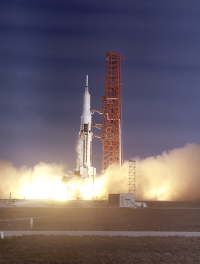
Saturn family of rockets
Wikipedia

Space Race
Wikipedia
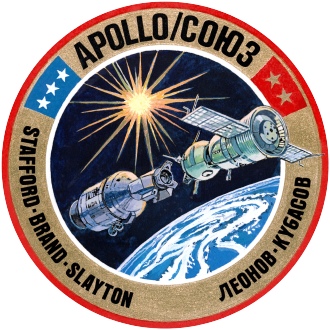
Apollo–Soyuz
Wikipedia

Apollo program
Wikipedia

Soyuz (spacecraft)
Wikipedia

Saturn (rocket family)
Wikipedia

Soviet Union
Wikipedia

United States
Wikipedia

Vuelo espacial
Wikipedia

Soviet space program
Wikipedia

Orbit
Wikipedia

Earth
Wikipedia

Dwight D. Eisenhower
Wikipedia

US Marines
Wikipedia

Lebanon
Wikipedia

Camille Chamoun
Wikipedia

علي حسن خليل
Wikipedia

دونالد شتاينر
Wikipedia

Biochemist
Wikipedia
What Else Happened on July 15
Rome dedicated the Temple of Castor and Pollux in the Forum to honor the divine twins who allegedly helped the Republic secure victory at the Battle of Lake Reg…
Titus and his Roman legions smashed through Jerusalem's breached walls, ending the city's desperate defense and sealing the fate of the Second Temple. This brut…
The Imperial Guards wouldn't march another step until she died. Yang Guifei, Emperor Xuanzong's beloved consort, was strangled by his chief eunuch on July 15, 7…

Three years of marching, starvation, plague, and slaughter across two continents ended on the walls of Jerusalem on July 15, 1099, when Crusader soldiers poured…
The Crusaders built their church directly over what they believed was Christ's tomb—while still fighting for control of the streets outside. Fifty years after c…
King John expelled the monks of Canterbury Cathedral after they backed Stephen Langton’s appointment as Archbishop against the King’s wishes. This confrontation…
Talk to History
Have a conversation with historical figures who witnessed this era. Ask questions, explore perspectives, and bring history to life.