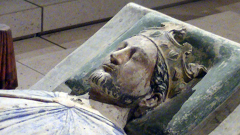
Lionheart Dies: Richard I's Arrow Ends a Reign
Richard I of England, the warrior-king who had fought across three continents, died on April 6, 1199, from a gangrenous crossbow wound sustained while besieging a minor castle in central France. The Lionheart had survived the Third Crusade, captivity in Austria, ransom by the Holy Roman Emperor, and five years of war against Philip II of France, only to be killed at Chalus-Chabrol by a lone defender armed with a frying pan as a shield. The irony was complete: the most celebrated soldier in Christendom was killed in a dispute over a cache of Roman gold coins. The wound itself was not immediately fatal. A crossbow bolt struck Richard in the left shoulder near the neck during an inspection of the siege lines on March 26. The surgeon who attempted to extract the bolt butchered the operation, enlarging the wound and leaving fragments of the shaft embedded in the flesh. Gangrene set in within days. Richard, recognizing he was dying, ordered the crossbowman who shot him, identified as Pierre Basile, to be brought before him. According to the chronicler Roger of Howden, Richard forgave the man and ordered his release, though after the king's death, the mercenary captain Mercadier had Basile flayed alive. Richard had spent only six months of his ten-year reign in England, viewing his island kingdom primarily as a source of revenue for his military campaigns. He spent the bulk of his reign fighting in the Holy Land during the Third Crusade, where he defeated Saladin at the Battle of Arsuf and negotiated a truce that preserved Christian access to Jerusalem, and then warring with Philip II of France over territories in Normandy and Aquitaine. His military reputation was extraordinary; Muslim chroniclers respected him as much as Christian ones. The financial burden of Richard's adventures was immense. His ransom alone, 150,000 marks of silver demanded by Holy Roman Emperor Henry VI, required a tax of 25 percent on all income and property in England. His castle-building program in France, centered on the massive Chateau Gaillard, consumed further fortunes. His death handed the English crown to his brother John, whose catastrophic reign produced the Magna Carta.
April 6, 1199
827 years ago
Key Figures & Places

What Else Happened on April 6
Julius Caesar's legions shattered the combined Republican forces at Thapsus in North Africa on April 6, 46 BC, in an engagement that devolved from battle into w…
Stilicho forced a tactical stalemate against Alaric’s Visigoths at the Battle of Pollentia, halting their initial invasion of Italy. By capturing the Visigothic…
Ayyubid Egyptian forces routed the French Crusader army and captured King Louis IX at the Battle of Fariskur, effectively destroying the Seventh Crusade in a si…
They burned their own king to keep him safe from the English crown. In 1320, Scottish nobles signed this letter at Arbroath Abbey, explicitly telling Pope John …
Petrarch first glimpsed Laura in the church of Saint Clare in Avignon, sparking a lifelong obsession that fueled his sonnets. This encounter transformed the ver…
He wasn't crowned in Lisbon's grand palace, but in the smoke-choked church of Aljubarrota, right after a battle where 14,000 men fell to stop a Spanish invasion…
Talk to History
Have a conversation with historical figures who witnessed this era. Ask questions, explore perspectives, and bring history to life.