

Blood on the Bridge: Selma's Bloody Sunday Sparks Civil Rights Victory
State troopers on horseback charged into 600 peaceful marchers on the Edmund Pettus Bridge in Selma, Alabama, on March 7, 1965, using tear gas, bullwhips, and rubber tubing wrapped in barbed wire. The assault was broadcast on national television that evening, interrupting ABC's Sunday night movie — a screening of Judgment at Nuremberg — and the juxtaposition of Nazi atrocities with American police violence against Black citizens produced a wave of public outrage that forced Congress to pass the Voting Rights Act within five months. The march was organized to protest the murder of Jimmie Lee Jackson, a 26-year-old Black man shot by an Alabama state trooper during a voting rights demonstration in nearby Marion on February 18. Jackson had been trying to protect his mother from a trooper's nightstick when he was shot in the stomach. He died eight days later. Civil rights leaders, including the Southern Christian Leadership Conference's James Bevel, proposed a march from Selma to the state capital in Montgomery, 54 miles away, to confront Governor George Wallace directly. John Lewis of the Student Nonviolent Coordinating Committee and Hosea Williams of the SCLC led the marchers out of Selma on Sunday afternoon. They crossed the Edmund Pettus Bridge, named for a Confederate general and Ku Klux Klan leader, and encountered a line of state troopers and county posse members commanded by Major John Cloud. Cloud ordered the marchers to disperse. When they did not move, the troopers attacked. Lewis suffered a fractured skull. Amelia Boynton Robinson was beaten unconscious. Tear gas enveloped the bridge as troopers on horseback rode down fleeing marchers. At least 17 people were hospitalized and more than 50 treated for injuries. Martin Luther King Jr., who had not participated in the march, called for clergy and supporters nationwide to come to Selma. Thousands responded. A second march attempt on March 9, led by King, turned back at the bridge after a federal court issued a restraining order. The full march to Montgomery finally took place March 21-25, under federal protection ordered by President Johnson. Johnson signed the Voting Rights Act on August 6, 1965, calling Selma the turning point. Within a year, Black voter registration in Selma rose from 2 percent to over 60 percent.
March 7, 1965
61 years ago
Key Figures & Places

civil rights
Wikipedia

Selma, Alabama
Wikipedia
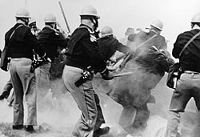
Bloody Sunday
Wikipedia

Selma to Montgomery marches
Wikipedia

Civil rights movement
Wikipedia

Selma, Alabama
Wikipedia

Alabama
Wikipedia

United States
Wikipedia

John Lewis
Wikipedia

Suffrage
Wikipedia

Marvelous Marvin Hagler
Wikipedia

Montgomery, Alabama
Wikipedia
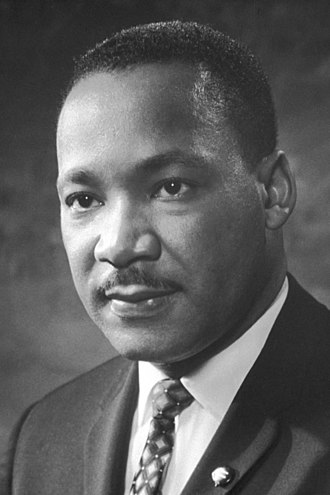
Martin Luther King Jr.
Wikipedia

George Wallace
Wikipedia

Tear gas
Wikipedia
Öffentliche Sicherheit
Wikipedia

Jimmy Carter
Wikipedia

Egypt
Wikipedia

Vietnam War
Wikipedia

Viet Cong
Wikipedia

أرماندو وولي
Wikipedia

حنان ترك
Wikipedia

السيد سعيد
Wikipedia

أحمد لوكسر
Wikipedia
كوكا (ممثلة)
Wikipedia

حمدي غيث
Wikipedia

نجيب الكيلاني
Wikipedia
What Else Happened on March 7
Antoninus Pius died after a peaceful twenty-three-year reign, leaving the Roman Empire to his adoptive sons, Marcus Aurelius and Lucius Verus. This transition e…
Rome got two emperors for the price of one when Marcus Aurelius refused to rule alone. His adoptive father Antoninus Pius had just died, and Marcus immediately …
The 80-year-old governor was reading poetry when the mob arrived demanding he become emperor. Gordian I hadn't sought power—African landowners rebelled against …

Emperor Constantine I declared the dies Solis — the day of the Sun — an official day of rest throughout the Roman Empire on March 7, 321 AD, and the world has o…
Macarius I refused to recant even as the emperor's guards dragged him from the council chamber. The Third Council of Constantinople had spent months debating wh…
Konrad III secured the German throne at Coblenz, backed by the papal legate Theodwin. This election formally launched the Hohenstaufen dynasty, initiating a cen…
Talk to History
Have a conversation with historical figures who witnessed this era. Ask questions, explore perspectives, and bring history to life.