Today In History
May 1 in History
Your birthday shares the stage with stories that shaped the world. Born on this day: Arthur Wellesley, Santiago Ramón y Cajal, and D'arcy Wretzky.

Navy SEALs Kill Bin Laden: Decade-Long Hunt Ends
A Black Hawk helicopter clipped the compound wall and crashed into the courtyard. The mission nearly failed before it began. Forty minutes later, U.S. Navy SEALs from DEVGRU emerged from a walled compound in Abbottabad, Pakistan, carrying the body of Osama bin Laden, the architect of the September 11 attacks that killed nearly 3,000 people. The raid, codenamed Operation Neptune Spear, culminated a decade-long intelligence hunt that traced bin Laden through a network of couriers. CIA analysts had spent months watching the three-story compound, just a mile from Pakistan's military academy, where a tall figure paced the garden but never left the grounds. President Barack Obama authorized the mission on April 29, 2011, choosing a direct assault over an airstrike to confirm the target's identity. Twenty-three SEALs fast-roped from modified Black Hawks shortly after midnight on May 2 local time (still May 1 in Washington). After the lead helicopter's hard landing, the team breached walls with explosives and fought upward through the house. Bin Laden was shot and killed on the third floor. DNA testing confirmed his identity within hours, and his body was buried at sea from the USS Carl Vinson before dawn. The killing reshaped the global counterterrorism landscape. Al-Qaeda's operational capacity, already degraded by years of drone strikes and leadership losses, never recovered its former reach. Pakistan faced intense scrutiny over how the world's most wanted fugitive had lived undetected near a military installation. For Americans, the moment carried a visceral emotional weight that few intelligence operations ever achieve. The compound was demolished nine months later. The empty lot remains.
Famous Birthdays
d. 1852
d. 1934
D'arcy Wretzky
b. 1968
Nikolai Yezhov
1895–1940
Anna Jarvis
d. 1948
Otto Kretschmer
d. 1998
Paul Teutul
b. 1974
S. M. Krishna
1932–2024
Historical Events
Two nations that had shared a monarch for a century but governed themselves separately chose, after years of bitter negotiation, to merge into one state. On May 1, 1707, the Acts of Union dissolved the separate parliaments of England and Scotland and created the Kingdom of Great Britain, forging the political entity that would dominate global affairs for the next two centuries. Scotland's path to union was paved by financial catastrophe. The Darien scheme, an attempt to establish a Scottish trading colony on the Isthmus of Panama in the late 1690s, consumed roughly a quarter of Scotland's liquid capital and ended in disease, Spanish hostility, and total failure. England, which had actively undermined the venture, now held enormous economic leverage over its northern neighbor. The treaty guaranteed Scotland's legal system, Presbyterian church, and education institutions would remain independent. Scottish nobles received financial compensation through the "Equivalent," a payment of nearly 400,000 pounds meant to offset Scotland's share of English national debt and compensate Darien investors. English negotiators secured what they wanted most: a unified foreign policy and the elimination of any possibility that Scotland might invite a rival monarch. Popular opposition in Scotland was fierce. Riots broke out in Edinburgh and Glasgow, and pamphlets warned of national extinction. The Scottish Parliament passed the treaty by 110 votes to 69, with allegations of bribery swirling around several members. Robert Burns would later write that Scotland's leaders had been "bought and sold for English gold." The union created the largest free-trade zone in Europe. Within decades, Scottish merchants, engineers, and soldiers became central to the expansion of the British Empire.
A Soviet SA-2 missile detonated near Francis Gary Powers' aircraft at 70,500 feet over Sverdlovsk, and the most dangerous diplomatic crisis between the Cold War superpowers since Berlin was underway. The CIA pilot survived, his Lockheed U-2 spyplane did not, and the wreckage that fell across Soviet farmland on May 1, 1960, carried enough intact equipment to prove exactly what the Americans had been doing. The U-2 program had been flying over Soviet territory since 1956, photographing military installations from altitudes the Soviets could track on radar but not reach with interceptors. The CIA believed the flights were untouchable. Powers' mission, designated Operation Grand Slam, was supposed to cross the entire Soviet Union from Pakistan to Norway, photographing ICBM sites along the way. Moscow's new S-75 surface-to-air missile system changed the calculus. The explosion damaged the U-2's tail and wings, sending it into an uncontrollable spin. Powers ejected and parachuted to the ground, where collective farm workers detained him. He was carrying a silver dollar containing a poison-tipped needle, which he chose not to use. Premier Nikita Khrushchev played the reveal brilliantly. He first announced only that an American plane had been shot down, letting Washington issue a cover story about a weather research aircraft gone astray. Then Khrushchev produced Powers, alive and confessing, along with the recovered camera equipment. President Eisenhower was caught in a public lie. The fallout was immediate: the Paris Summit collapsed two weeks later, and Eisenhower's planned visit to Moscow was canceled. Powers served 21 months in a Soviet prison before being exchanged for KGB spy Rudolf Abel on Berlin's Glienicke Bridge in February 1962.
A Black Hawk helicopter clipped the compound wall and crashed into the courtyard. The mission nearly failed before it began. Forty minutes later, U.S. Navy SEALs from DEVGRU emerged from a walled compound in Abbottabad, Pakistan, carrying the body of Osama bin Laden, the architect of the September 11 attacks that killed nearly 3,000 people. The raid, codenamed Operation Neptune Spear, culminated a decade-long intelligence hunt that traced bin Laden through a network of couriers. CIA analysts had spent months watching the three-story compound, just a mile from Pakistan's military academy, where a tall figure paced the garden but never left the grounds. President Barack Obama authorized the mission on April 29, 2011, choosing a direct assault over an airstrike to confirm the target's identity. Twenty-three SEALs fast-roped from modified Black Hawks shortly after midnight on May 2 local time (still May 1 in Washington). After the lead helicopter's hard landing, the team breached walls with explosives and fought upward through the house. Bin Laden was shot and killed on the third floor. DNA testing confirmed his identity within hours, and his body was buried at sea from the USS Carl Vinson before dawn. The killing reshaped the global counterterrorism landscape. Al-Qaeda's operational capacity, already degraded by years of drone strikes and leadership losses, never recovered its former reach. Pakistan faced intense scrutiny over how the world's most wanted fugitive had lived undetected near a military installation. For Americans, the moment carried a visceral emotional weight that few intelligence operations ever achieve. The compound was demolished nine months later. The empty lot remains.
Joseph Goebbels was Hitler's Minister of Propaganda for twelve years, the architect of the Nazi media apparatus that controlled every newspaper, radio station, film studio, and public event in Germany. On May 1, 1945, one day after Hitler's suicide, he killed his six children and then himself in the garden of the Reich Chancellery in Berlin. Born in Rheydt, in the Rhineland, on October 29, 1897, Goebbels had a clubfoot from birth, the result of osteomyelitis, which exempted him from military service in World War I and caused him lifelong physical insecurity. He earned a doctorate in German philology from the University of Heidelberg in 1921 and initially pursued a literary career before being drawn to the Nazi movement in the mid-1920s. He joined the party in 1924 and rose quickly through its ranks. Hitler appointed him Gauleiter (regional leader) of Berlin in 1926, where he turned the party's street violence into political theater. He created the myth of Horst Wessel, a murdered SA stormtrooper, as a Nazi martyr. He organized rallies, torchlight parades, and provocations designed to generate media coverage. When Hitler became Chancellor in 1933, Goebbels was made Minister of Public Enlightenment and Propaganda. He centralized control over all German media, banned opposition newspapers, coordinated the burning of books by Jewish, communist, and politically undesirable authors, and oversaw the production of propaganda films including Triumph of the Will and The Eternal Jew. His ministry controlled what Germans could read, hear, and see. He kept a diary that documented Nazi decision-making with disturbing clarity and self-awareness. He was present at discussions of the Final Solution. He organized the pogrom of Kristallnacht in November 1938. He managed public morale during the bombing campaigns and the military reversals of 1943-1945. He was Chancellor of Germany for one day, May 1, 1945, appointed in Hitler's will. That afternoon, he and his wife Magda poisoned their six children with cyanide capsules in the Fuhrerbunker. The children ranged in age from four to twelve. Both parents then killed themselves in the Chancellery garden.
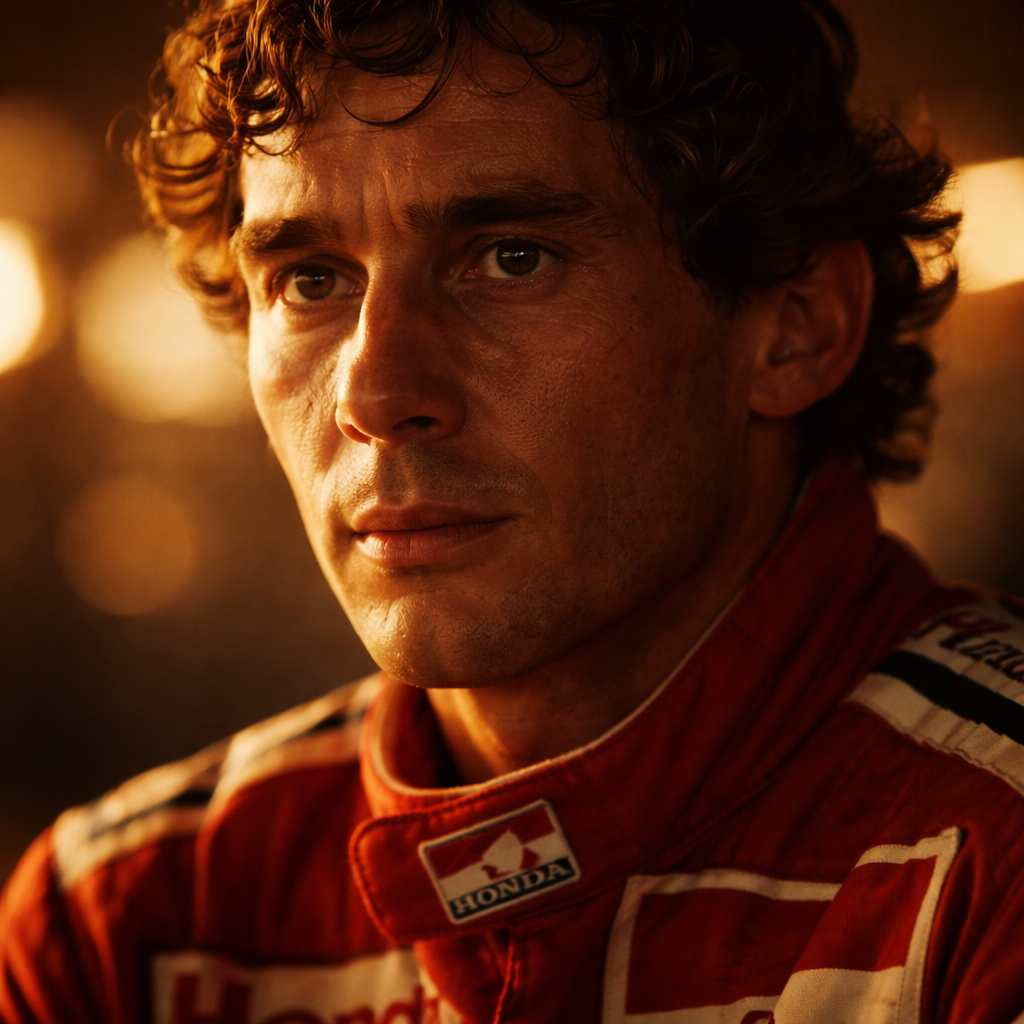
The Williams FW16 left the racing line at 191 mph, crossed the run-off area, and struck the concrete wall at Tamburello corner with an impact that registered on seismographs at the University of Bologna. Ayrton Senna, three-time Formula One world champion and the driver many considered the fastest who ever lived, was killed instantly at the Imola circuit on May 1, 1994. The weekend had already been catastrophic. Austrian driver Roland Ratzenberger died in qualifying the day before after his front wing failed at the Villeneuve curve. Rubens Barrichello had survived a violent crash on Friday. Senna, deeply shaken by Ratzenberger's death, reportedly considered withdrawing but chose to race, carrying an Austrian flag he planned to unfurl in tribute on the victory lap. On lap seven, Senna's car failed to turn through the high-speed Tamburello curve. The investigation concluded that the steering column, which had been cut and re-welded to accommodate Senna's driving position, fractured from metal fatigue. A suspension arm pierced his helmet visor on impact. He was airlifted to Maggiore Hospital in Bologna, where he was pronounced dead that afternoon. The grief was global but nowhere deeper than in Brazil, where Senna transcended sport. Three days of national mourning were declared. An estimated three million people lined the streets of Sao Paulo for his funeral procession. He had won 41 Grand Prix races and three championships, but his legend rested as much on his rain-driving mastery and his rivalry with Alain Prost as on statistics. Senna's death transformed Formula One safety. The FIA mandated sweeping circuit redesigns, introduced the HANS device development program, and restructured crash testing. Tamburello was rebuilt as a chicane. No driver died in an F1 race for the next 20 years.
The blast reached the surface as a column of flame and debris that shot from the mine entrance and scattered timbers across the mountainside. At 10:28 on the morning of May 1, 1900, an explosion ripped through Mine Number Four of the Winter Quarters complex in Scofield, Utah, killing over 200 miners in what remains one of the deadliest industrial disasters in American history. Scofield was a company town owned by the Pleasant Valley Coal Company, which supplied fuel to the Union Pacific Railroad. The mine employed virtually every working-age man in the community. Miners entered the tunnels at 10:24, just four minutes before the explosion. The blast was caused by coal dust ignited either by a blown-out blasting charge or an open flame, though the exact trigger was never determined. The explosion's force was so violent that it reversed airflow through connecting tunnels and killed miners in the adjacent Mine Number One, nearly half a mile away. Rescue teams found bodies in clusters, some still holding lunch pails. Many victims showed no burns or injuries; they had suffocated on afterdamp, the toxic mixture of carbon monoxide and carbon dioxide that fills mines after an explosion. Of the town's roughly 1,800 residents, 200 men and boys died. Some families lost every male member. The youngest victim was fourteen. Every household in Scofield was directly affected, and the funeral processions continued for days. The disaster left over a hundred widows and several hundred orphaned children in a community with no other economic base. The tragedy prompted Utah to create the State Mine Inspector's office and pass new ventilation requirements. Similar reforms followed in other mining states, though enforcement remained weak for decades. The Scofield cemetery, where victims are buried in long rows, is now a state memorial.
Kim Il-sung was thirty-six years old and had spent a decade in the Soviet Union when Moscow installed him as the leader of a new state above the 38th parallel. The Democratic People's Republic of Korea, proclaimed on September 9, 1948, formalized a division that began as a temporary wartime arrangement and became one of the most enduring geopolitical fractures on Earth. The division originated in August 1945, when two American officers used a National Geographic map to draw a line across the Korean Peninsula. The 38th parallel split a nation that had existed as a unified entity for over a thousand years. Soviet forces occupied the north, American forces the south, and both installed governments that reflected their sponsors' ideologies. Kim had fought with Chinese and Soviet partisan units against the Japanese in Manchuria during the 1930s, eventually commanding a Korean battalion in the Soviet Red Army. His guerrilla credentials gave him legitimacy among Korean nationalists, but his rise to power owed everything to Soviet patronage. Moscow trained him, promoted him, and cleared his rivals from the Korean Workers' Party through a series of purges in 1946 and 1947. The new constitution established a centrally planned economy, nationalized industry and land, and concentrated power in the party apparatus. Kim quickly built a personality cult modeled on Stalin's, portraying himself as the singular liberator of the Korean people from Japanese colonialism. Two years after the state's founding, Kim invaded the south, launching the Korean War. The three-year conflict killed over two million civilians, drew in American and Chinese armies, and ended in an armistice that restored roughly the same border. The Kim dynasty still rules North Korea, making it the longest-running family dictatorship in modern history.
Philippine President Gloria Macapagal-Arroyo declared a "state of rebellion" on May 1, 2000, hours after thousands of supporters of her imprisoned predecessor, Joseph Estrada, stormed toward the presidential palace during the EDSA III uprising. The demonstration was the culmination of months of political turmoil that had begun when Estrada was ousted from the presidency in January 2001 through the second "People Power" revolution, known as EDSA II. Estrada, a former movie star who had won the 1998 presidential election on a populist platform promising to help the poor, was accused of receiving millions of pesos in payoffs from illegal gambling syndicates. His impeachment trial in the Senate collapsed when pro-Estrada senators blocked the opening of a crucial bank envelope that prosecutors said contained evidence of his hidden wealth. The blocked vote triggered massive demonstrations that brought millions into the streets. The military withdrew its support from Estrada, and the Supreme Court declared the presidency vacant. Arroyo, who had been Estrada's vice president, was sworn in. Estrada's supporters, predominantly from Manila's poor neighborhoods, viewed his removal as a middle-class coup against a leader who represented their interests. The EDSA III march on the presidential palace was an attempt to replicate the people-power formula that had brought Arroyo to office. Arroyo's declaration of a state of rebellion enabled the security forces to conduct mass arrests and disperse the crowd. Order was restored within days, but the episode deepened political divisions that haunted Philippine democracy for years. Estrada was later convicted of plunder but pardoned by Arroyo, and he eventually served as mayor of Manila.
Magda Goebbels poisoned her six children in the Führerbunker on May 1, 1945, before taking her own life alongside her husband, Joseph Goebbels, who shot himself after a cyanide capsule. The children, ranging in age from 4 to 12, were sedated with morphine and then given cyanide capsules that were crushed in their mouths. Born Johanna Maria Magdalena Behrend on November 11, 1901, in Berlin, she married the Nazi propaganda minister in 1931, and the couple became central figures in the regime's domestic image, their photogenic family presented as the ideal National Socialist household. The deliberate murder of her children represented the ultimate expression of ideological totality: the belief that life outside the Nazi system was not merely undesirable but impossible. In the final weeks of the war, as Soviet forces encircled Berlin, multiple people offered to evacuate the children. Albert Speer claimed to have proposed a rescue plan. Magda Goebbels refused every offer. She reportedly told Speer that she could not bear for her children to grow up in a world without National Socialism, believing that the system's collapse meant the destruction of everything that gave life meaning. The children had been paraded at propaganda events, photographed with Hitler, and presented as symbols of the regime's idealized future. They became instead the most devastating evidence of its psychological grip on those closest to its center. The bodies were burned outside the bunker by SS soldiers. Soviet troops found the remains the following day. The Goebbels children have become one of the most disturbing footnotes of the war, a reminder that fanaticism can override even the most fundamental human instinct.
Sigismund drowned his own son in a well years earlier, pushed by his second wife's accusations of treason. The boy was innocent. When Sigismund tried to flee after losing his kingdom, Frankish forces caught him and dragged him to Orléans. Eight years as king of Burgundy, ended with an executioner's blade in 524. His brother Godomar took the throne but lasted only a decade before the Franks absorbed Burgundy entirely. The kingdom Sigismund murdered his heir to protect didn't even survive a generation. Sometimes paranoia doesn't just destroy families—it destroys nations.
The roof alone took twelve tons of gold leaf. Basil I wanted something impossible: a church large enough to hold relics from seventeen saints, built on a foundation that couldn't support it. Engineers said no. He built it anyway, propping the whole thing on a network of underground cisterns and lead-reinforced arches. The Nea Ekklesia didn't just look different from the old basilicas—it was structurally different, a Greek cross under four supporting domes. And when it didn't collapse, every Orthodox architect for the next thousand years copied the blueprint. Sometimes stubbornness is indistinguishable from vision.
Three ships. Thirty knights. Sixty men-at-arms in rusted mail. That's all it took to crack Ireland open. Diarmait Mac Murchada hired them because his own countrymen had kicked him out of Leinster. The Normans waded ashore at Bannow Bay on May 1st, 1169, not as conquerors but as mercenaries collecting a debt. They brought longbows, cavalry tactics, and castle-building expertise the Irish had never seen. Within two years, they'd stopped taking orders from Diarmait. Sometimes an invasion starts because someone couldn't let go of a crown.
Robert the Bruce got everything he wanted, but he'd been excommunicated for fourteen years when England finally signed. The Treaty of Edinburgh-Northampton in 1328 recognized Scotland as independent—not through negotiation, really, but because Edward II was dead and his teenage son needed peace. Bruce paid £20,000 for it. Called the "Shameful Peace" in England, celebrated in Scotland. Four years of truce. Then Bruce died, his son was five, and Edward III tore up the treaty the moment he could. Independence recognized. Just not respected.
The signatures were still wet when Jews started selling their homes for a donkey, their vineyards for a bolt of cloth. Ferdinand and Isabella gave Spain's 200,000 Jews exactly four months—not to convert, but to leave. Anyone baptized could stay with full rights. Anyone who refused forfeited everything: property, gold, even the right to take currency across the border. Most fled to Portugal, only to be expelled again five years later. Christopher Columbus, funded by the same monarchs with confiscated Jewish wealth, set sail for the Americas the day after the final deadline.
Anna Jagiellon was thirty-two and unmarried—practically unheard of for a Jagiellonian princess. She'd watched three elected kings come and go. Then Poland's nobles chose her husband for her: Stephen Báthory, a Transylvanian military commander thirteen years younger who'd never set foot in Warsaw. The wedding happened in Kraków on May 1st. She brought legitimacy and a crown. He brought an army and a talent for war against Ivan the Terrible. Within a decade, he'd tripled Commonwealth territory eastward. Turns out arranged marriages sometimes work when both sides need something desperately.
Fun Facts
Zodiac Sign
Taurus
Apr 20 -- May 20
Earth sign. Patient, reliable, and devoted.
Birthstone
Emerald
Green
Symbolizes rebirth, fertility, and good fortune.
Next Birthday
--
days until May 1
Quote of the Day
“Books are the legacies that a great genius leaves to mankind, which are delivered down from generation to generation as presents to the posterity of those who are yet unborn.”
Share Your Birthday
Create a beautiful birthday card with events and famous birthdays for May 1.
Create Birthday CardExplore Nearby Dates
Popular Dates
Explore more about May 1 in history. See the full date page for all events, browse May, or look up another birthday. Play history games or talk to historical figures.