

Historical Figure
Guru Gobind Singh
1666–1708
Tenth Sikh guru from 1675 to 1708
Talk to Guru Gobind Singh
Have a conversation with this historical figure through AI
Biography
Guru Gobind Singh was the tenth and last human Sikh Guru. He was a warrior, poet, and philosopher. In 1675, at the age of nine, he was formally made the leader of the Sikhs after his father Guru Tegh Bahadur—the ninth Sikh Guru—was executed by the emperor Aurangzeb. His four biological sons died during his lifetime—two in battle and two executed by the Mughal administrator Wazir Khan.
Timeline
The story of Guru Gobind Singh, told in moments.
Born Gobind Rai in Patna, Bihar. His father was Guru Tegh Bahadur, the ninth Sikh Guru. At age nine, he asked his father why the Kashmiri Pandits were being persecuted. The answer set everything in motion.
His father was executed in Delhi by Mughal emperor Aurangzeb for refusing to convert to Islam. Gobind became Guru at age nine. The youngest leader of a community at war.
Created the Khalsa at Vaisakhi. Asked for five volunteers willing to die. Each walked into his tent. Each came out alive, wearing the five articles of faith. The community was reborn that day.
Lost all four sons in the wars against the Mughals. The two eldest died in battle at Chamkaur. The two youngest, ages 6 and 9, were bricked alive at Sirhind by the provincial governor.
Died at Nanded from wounds inflicted by assassins. Before dying, he declared the Guru Granth Sahib, the holy scripture, as the eternal Guru. No more human successors.
In Their Own Words (7)
"Though you are the king of kings, O Aurangzeb! you are far from righteousness and justice. I vanquished the vicious hill chiefs, they were idol-worshippers and I am idol-breaker. [94-95]"
Arun Shourie, quoted in Elst, Koenraad (2002). Who is a Hindu?: Hindu revivalist views of Animism, Buddhism, Sikhism, and other offshoots of Hinduism. ISBN 978-8185990743, 2002
Govind Rai, the tenth and last guru (1676 — 1708) and the only son of Tegh Bahadur, was a man of whom it had been prophesied before his birth that ‘’he would convert jackals into tigers and sparrows into hawks." He was not the person to leave his father’s death unavenged. [...] Govind steadily drilled his followers, gave them a distinctive dress and a new oath of baptism... “Mother dear, I have been considering how I may confer empire on the Khalsa. ’ ’ And, again, “I shall make men of all four castes lions and destroy the Mughals.’’
1676
"Someone worshipped stone and placed it on his head. Someone hung the phallus (lingam) from his neck. Someone visualized God in the South and someone bowed his head towards the West. Some fool worships the idols and someone goes to worship the dead. The whole world is entangled in false rituals and has not known the secret of God. [30]."
"Salutation to Him, Who is Primal and Immortal. He hath Created millions of Krishnas like worms. He Created them, annihilated them, again destroyed them, still again Created them. He is Unfathomable, Fearless, Primal, Non-dual and Indestructible. Yonder and Yonder is He, the supreme Lord, He is the Perfect Illuminator. [96]"
"When all other methods fail, it is proper to hold the sword in hand. [22]"
Artifacts (15)
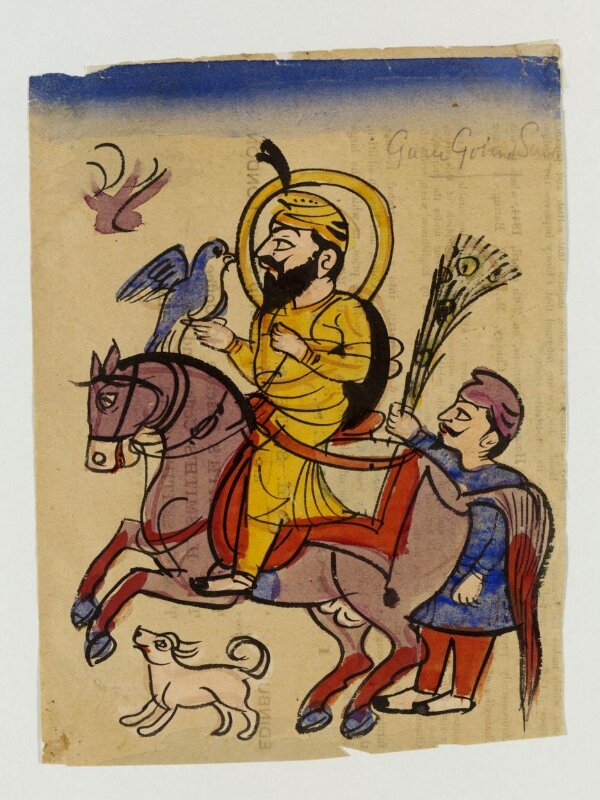
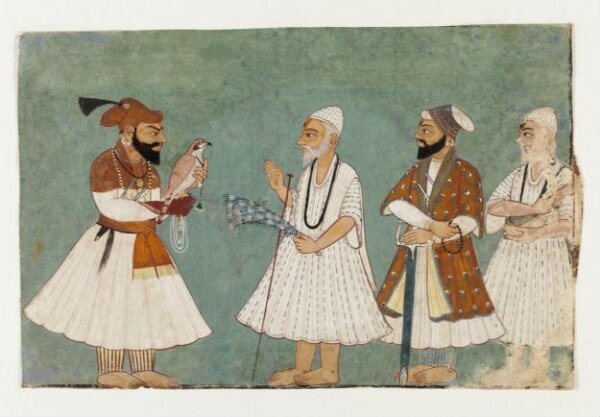

Maharao Guman Singh Riding an Elephant in Procession
More from the Early Modern


Explore what happened on the days that shaped Guru Gobind Singh's life. Today In History connects historical figures with the events, births, and deaths that defined their era. Browse all historical figures or explore today's events.