Swedish Double Envelopment: Fraustadt Decimates Coalition
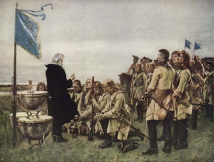
Swedish Field Marshal Carl Gustaf Rehnskiold executed one of the most devastating tactical victories in military history at Fraustadt on February 3, 1706, destroying a combined Saxon-Polish-Russian force three times his size through a textbook double envelopment. The battle lasted barely two hours. Roughly 7,000 of the coalition’s 20,000-plus soldiers were killed, and another 8,000 were captured. Swedish losses numbered fewer than 400. The Great Northern War had been raging since 1700, with Sweden’s young King Charles XII fighting a coalition of Russia, Saxony-Poland, and Denmark that sought to dismantle the Swedish Empire. By 1706, Charles had already knocked Denmark out of the war and was campaigning deep in Poland. Rehnskiold commanded the Swedish forces in the western theater while Charles pursued the main Saxon-Polish army further east. The coalition force under Saxon General Johann Matthias von der Schulenburg held a strong position near the town of Fraustadt in western Poland, with its flanks anchored by frozen marshes. Rehnskiold deployed his 9,400 troops in a concave formation, placing his cavalry on both wings and his weaker infantry in the center. The Swedish cavalry swept around the flanks, collapsed the coalition wings, and drove inward to encircle the center. The Russian contingent, positioned on the Saxon left flank, fought stubbornly but was overwhelmed and largely massacred after the battle. Contemporary accounts describe Swedish troops killing surrendering Russians, one of the war’s documented atrocities. The victory at Fraustadt, combined with Charles XII’s simultaneous advance on Saxony, forced Augustus II to sign the Treaty of Altranstadt later that year, temporarily removing Saxony-Poland from the war. Military historians rank Fraustadt alongside Cannae and Austerlitz as a masterpiece of the double envelopment. Rehnskiold had proven that audacity and superior cavalry could overcome a three-to-one numerical disadvantage.
February 3, 1706
320 years ago
Key Figures & Places

What Else Happened on February 3
The Normans conquered Southern Italy because younger sons had nothing to inherit back home. Drogo of Hauteville was one of twelve brothers who left Normandy as …
Ramon Berenguer III of Barcelona married Douce I of Provence in 1112, and the wedding ceremony produced something far more consequential than an heir to either …
Cardinal Robert of Geneva ordered the massacre of over 2,000 residents of Cesena on February 3, 1377, earning himself the permanent title "Butcher of Cesena" an…
Sultan Mehmed II ascended the Ottoman throne, inheriting a fractured empire and a precarious geopolitical position. Two years later, he orchestrated the fall of…
Bartolomeu Dias sailed past the southern tip of Africa without even realizing it, blown so far off course by a ferocious storm in early 1488 that when he finall…
Portugal crushed a combined fleet of Ottoman, Mamluk, and Indian forces off the coast of Diu, securing a decisive naval victory. This triumph ended Muslim domin…
Talk to History
Have a conversation with historical figures who witnessed this era. Ask questions, explore perspectives, and bring history to life.