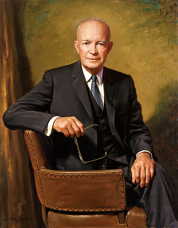
NASA Founded: America Rallies Against Sputnik
President Dwight Eisenhower signed the National Aeronautics and Space Act on July 29, 1958, creating NASA and transforming a nation's humiliation into an institutional commitment to explore the cosmos. Ten months earlier, a Soviet satellite the size of a beach ball had shattered American confidence in its technological supremacy. Sputnik's launch on October 4, 1957, triggered a genuine crisis. Americans who had assumed their country led the world in science and engineering watched a communist satellite pass overhead every ninety-six minutes, beeping. The military's response was embarrassing: the Navy's Vanguard rocket exploded on the launch pad in December 1957, broadcast live on national television. Newspapers dubbed it "Flopnik" and "Kaputnik." The Soviet Union, meanwhile, launched a second satellite carrying a dog named Laika, demonstrating capabilities that suggested intercontinental nuclear missiles were not far behind. Eisenhower, a former general deeply wary of military influence in government, made a deliberate decision to separate civilian space exploration from the Pentagon. The Act established NASA as an independent agency focused on peaceful scientific and aeronautical research, drawing primarily from the existing National Advisory Committee for Aeronautics and absorbing several military research programs. The distinction between civilian and military space activity was both philosophical and strategic: it signaled to the world that American space ambitions were not solely weapons-driven. NASA opened for business on October 1, 1958, with approximately 8,000 employees and an annual budget of $100 million. Within a decade, that budget would grow to $5.9 billion and the agency would employ over 400,000 people across government and contractor workforces. The Mercury, Gemini, and Apollo programs followed in rapid succession, each building toward President Kennedy's 1961 challenge to reach the Moon. From a panicked reaction to a Soviet satellite, NASA became the organization that put human footprints on another world eleven years after its founding.
July 29, 1958
68 years ago
Key Figures & Places

What Else Happened on July 29
Nebuchadnezzar II’s forces breached the walls of Jerusalem, systematically dismantling the First Temple and deporting the city’s elite to Babylon. This destruct…
The Praetorian Guard broke into the palace and found two emperors arguing. Pupienus and Balbinus had ruled Rome together for 99 days, spending most of it feudin…
Twelve years old and they handed him a collapsing kingdom. K'inich Janaab Pakal became ajaw of Palenque on July 29, 615, after enemies had sacked the city and k…
Twenty-two thousand residents of Thessaloniki were chained together and marched to slave markets across the Caliphate—the largest single human haul from a Byzan…
King Rudolph II and Margrave Adalbert I of Ivrea crushed the forces of dethroned Emperor Berengar I at Firenzuola in Tuscany, ending his last viable bid to recl…
Emperor Basil II annihilated the Bulgarian army at the Battle of Kleidion, then ordered the blinding of 15,000 prisoners, leaving one eye to every hundredth man…
Talk to History
Have a conversation with historical figures who witnessed this era. Ask questions, explore perspectives, and bring history to life.