California Opens First Freeway: Roads to the Future
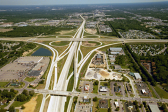
California opened the Arroyo Seco Parkway on December 30, 1940, connecting downtown Los Angeles to Pasadena along a six-mile ribbon of concrete that became the first freeway in the Western United States and the template for the car-dependent sprawl that would define American urban life for the next century. Governor Culbert Olson cut the ribbon before a crowd of thousands, and motorists immediately flooded onto the road, reaching Pasadena from downtown in just twelve minutes instead of the usual forty-five. The parkway had been conceived in the early 1930s as a scenic divided highway through the Arroyo Seco canyon, inspired by the landscaped parkways of the eastern United States. Engineers designed graceful curves, stone-faced bridges, and planted median strips that gave the road an aesthetic quality that later freeways would abandon entirely in favor of pure throughput. The speed limit was set at 45 miles per hour, and the acceleration lanes were just a few car lengths long, designed for vehicles that topped out at 60 mph and weighed half as much as modern SUVs. Traffic volumes exceeded projections from day one, and within a year the parkway carried twice its design capacity. The success convinced planners that limited-access highways solved urban congestion, launching a freeway boom that produced the 45,000-mile Interstate Highway System authorized by the Federal-Aid Highway Act of 1956. The consequences were deeply contradictory. Freeways enabled explosive suburban growth but destroyed urban neighborhoods, particularly communities of color, through which roads were deliberately routed. The Arroyo Seco Parkway was designated a National Scenic Byway, preserved as a relic of more optimistic highway design. Its tight curves and short merge lanes, charming in 1940, are terrifying at modern speeds, earning one of the highest accident rates per mile in California.
December 30, 1940
86 years ago
Key Figures & Places
What Else Happened on December 30
The first edition lasted exactly one year. Justinian scrapped it completely—too many contradictions, too many loopholes left by a thousand years of Roman law st…
King Brian Boru shatters the allied armies of Leinster and Dublin at Glenmama, ending their resistance to his rule. This crushing victory secures Munster's domi…
Joseph ibn Naghrela wasn't just any vizier — he was the most powerful Jew in Muslim Spain, commanding armies and collecting taxes for Granada's Berber king. Tha…
The English fleet arrived at La Rochelle expecting an easy siege. Instead, they found Castilian warships waiting — their cogs bristling with new gunpowder weapo…
Richard of York rode into a trap with 8,000 men. The Lancastrians had 18,000 waiting outside Wakefield. His teenage son Edmund tried to flee the battlefield — t…
Lancastrian forces crushed the Yorkist army at the Battle of Wakefield, killing Richard, 3rd Duke of York, on the field. This defeat decapitated the Yorkist lea…
Talk to History
Have a conversation with historical figures who witnessed this era. Ask questions, explore perspectives, and bring history to life.