

Treaty of Ghent Signed: War of 1812 Officially Over
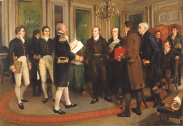
They signed peace two weeks before the war's bloodiest battle. The Treaty of Ghent ended the War of 1812 on Christmas Eve, but news traveled at sailing speed — so 2,000 men died at New Orleans in January fighting for a war already over. Britain and America returned to status quo ante bellum: every border back where it started, every captured territory returned, nothing gained. Three years of fighting. 15,000 dead. Zero land changed hands. But it worked — the two nations never fought again. Sometimes the most important victory is just deciding to stop.
December 24, 1814
212 years ago
Key Figures & Places
What Else Happened on December 24
Emperor Wu of Liang elevated his eldest son, Xiao Tong, to heir designate, cementing the succession of the Liang dynasty. This decision ensured the continuity o…

The dome collapsed. Five years of work, gone in seconds. Justinian's architects had pushed Roman engineering to its limit — a dome 180 feet across, floating on …
la iglesia bizantina Santa Sofía en Constantinopla es reconstruida por segunda vez después haber sido destruida por un terremoto.
A Syrian priest becomes the first pope from the Eastern Church. John IV takes the throne during a theological bloodbath — the Monothelite controversy has bishop…
Several months of vacancy. No pope, no guidance, and Rome's clergy couldn't agree. Then they chose John, a Dalmatian from what's now Croatia — rare for a pontif…
Du Fu fled the chaos of the An Lushan Rebellion, seeking refuge in Chengdu under the hospitality of his friend Pei Di. This relocation sparked a period of immen…
Talk to History
Have a conversation with historical figures who witnessed this era. Ask questions, explore perspectives, and bring history to life.