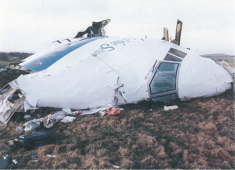
Lockerbie Bombs Fall: Pan Am Flight 103 Destroyed
A radar blip vanished from screens at 7:03 PM over the Scottish countryside, and within seconds, 270 people were dead. Pan Am Flight 103, a Boeing 747 en route from London Heathrow to New York JFK, disintegrated at 31,000 feet on December 21, 1988, after a Semtex plastic explosive hidden inside a Toshiba radio-cassette player detonated in the forward cargo hold. The explosion tore a twenty-inch hole in the fuselage, triggering catastrophic structural failure. The aircraft broke apart in midair, with the nose section separating within three seconds. Large sections of the fuselage, engines, and wings rained down on the town of Lockerbie, Scotland, where a fireball from the wing fuel tanks destroyed an entire row of houses on Sherwood Crescent, killing eleven residents on the ground. All 243 passengers and 16 crew members perished, making it the deadliest terrorist attack in British history at that time. A joint investigation by Scottish police and the FBI became one of the largest criminal inquiries ever conducted, examining over 10,000 pieces of evidence recovered across 845 square miles of countryside. A fingernail-sized fragment of circuit board, traced to a Swiss-manufactured timer, ultimately linked the bomb to Libyan intelligence operatives. In 2001, Abdelbaset al-Megrahi was convicted of 270 counts of murder at a special Scottish court convened in the Netherlands. The Lockerbie bombing transformed aviation security worldwide. Within two years, the FAA mandated passenger-baggage matching on international flights and required thermal neutron analysis screening for checked luggage. Libya eventually accepted responsibility in 2003 and paid $2.7 billion in compensation to victims families, though the full chain of command behind the attack remains disputed to this day.
December 21, 1988
38 years ago
Key Figures & Places

What Else Happened on December 21
The Roman Senate officially recognized Vespasian as emperor, finally ending the chaotic civil wars of 69 AD. By consolidating power under the Flavian dynasty, h…
Four emperors in twelve months. Rome's throne changed hands faster than anyone could mint new coins — Galba murdered by his own guards, Otho dead by suicide aft…
Muslim forces breached the Babylon Fortress after a grueling seven-month siege, dismantling Byzantine control over Egypt. This victory secured the Nile Delta fo…
Lamberto Scannabecchi became Pope Honorius II through pure chaos. Cardinals split between two rivals, then a third faction literally grabbed Lamberto during the…
Pope Honorius II ascended to the papacy after the abrupt resignation of Celestine II, who stepped down mid-ceremony under pressure from the powerful Frangipani …
Conrad III accepted the surrender of Weinsberg after a grueling siege, but he allowed the city’s women to evacuate carrying only what they could hold on their b…
Talk to History
Have a conversation with historical figures who witnessed this era. Ask questions, explore perspectives, and bring history to life.