First Crossword Published: A Word-Cross Is Born
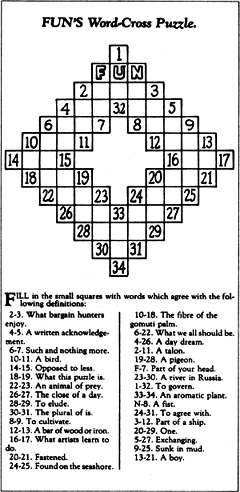
Arthur Wynne sat at his desk at the New York World newspaper, staring at a deadline for the Sunday supplement "Fun" section, and sketched out a diamond-shaped grid with numbered clues that would become the most enduring word game in publishing history. His "Word-Cross" puzzle, published on December 21, 1913, looked nothing like the black-and-white grids familiar today. The diamond shape had no internal black squares, clues were simple definitions, and the puzzle contained words like "dove," "more," and "hard." Wynne, a Liverpool-born journalist who had emigrated to the United States, was drawing on a long tradition of word games. Victorian-era publications had featured word squares and acrostic puzzles for decades. His innovation was combining numbered clue lists with an interlocking grid where answers shared letters, creating a puzzle that demanded both vocabulary and spatial reasoning. A typographical error in a subsequent edition accidentally transposed the name to "Cross-Word," and the new name stuck permanently. Reader response was immediate and enthusiastic. The puzzle became the most popular feature in the World supplement, generating floods of reader mail. Other newspapers initially dismissed it as a fad, but by 1924, the newly formed publishing house Simon and Schuster released the first book of crossword puzzles, which became a runaway bestseller. The New York Times, which had editorially mocked the crossword craze as "a sinful waste of time," finally introduced its own daily crossword in 1942 and has published one every day since. Crossword puzzles now appear in virtually every newspaper worldwide and generate hundreds of millions of dollars annually in books, apps, and digital subscriptions. Research has consistently shown that regular crossword solving correlates with delayed onset of cognitive decline, giving Wynne accidental legacy as a contributor to public health.
December 21, 1913
113 years ago
Key Figures & Places
What Else Happened on December 21
The Roman Senate officially recognized Vespasian as emperor, finally ending the chaotic civil wars of 69 AD. By consolidating power under the Flavian dynasty, h…
Four emperors in twelve months. Rome's throne changed hands faster than anyone could mint new coins — Galba murdered by his own guards, Otho dead by suicide aft…
Muslim forces breached the Babylon Fortress after a grueling seven-month siege, dismantling Byzantine control over Egypt. This victory secured the Nile Delta fo…
Lamberto Scannabecchi became Pope Honorius II through pure chaos. Cardinals split between two rivals, then a third faction literally grabbed Lamberto during the…
Pope Honorius II ascended to the papacy after the abrupt resignation of Celestine II, who stepped down mid-ceremony under pressure from the powerful Frangipani …
Conrad III accepted the surrender of Weinsberg after a grueling siege, but he allowed the city’s women to evacuate carrying only what they could hold on their b…
Talk to History
Have a conversation with historical figures who witnessed this era. Ask questions, explore perspectives, and bring history to life.