

Edward VIII Abdicates: Love Over Crown
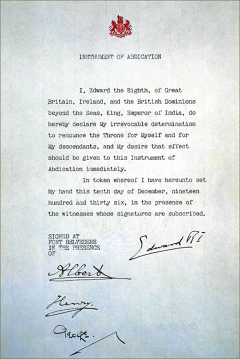
A king chose love over an empire. Edward VIII, barely eleven months into his reign as King of the United Kingdom and Emperor of India, signed the instrument of abdication on December 10, 1936, making it effective the following day. His crime, in the eyes of the British Establishment, was falling in love with Wallis Simpson, a twice-divorced American socialite whom the government deemed unfit to be queen. The crisis had been building for months behind closed doors. Prime Minister Stanley Baldwin made clear that the British public and the Dominion governments would never accept Simpson as queen consort. The Church of England, of which Edward was nominal head, refused to sanction marriage to a divorced woman whose former husbands still lived. Edward was offered a morganatic marriage compromise, where Simpson would become his wife but not queen, yet both Baldwin and the Dominion prime ministers rejected even that half-measure. Edward refused to abandon Simpson. On December 11, he broadcast a radio address to the nation, declaring he found it "impossible to carry the heavy burden of responsibility and to discharge my duties as King as I would wish to do without the help and support of the woman I love." His brother Albert ascended the throne as George VI, the shy, stammering prince suddenly thrust into a role he never wanted. Edward received the title Duke of Windsor and married Simpson six months later in France. The couple lived in exile for decades, never fully reconciled with the royal family. George VI, meanwhile, guided Britain through World War II, his unexpected kingship producing one of the most consequential reigns of the twentieth century. The abdication remains the only voluntary renunciation of the British throne in modern history, a reminder that even the most powerful institution in the Commonwealth could not compel a man to choose duty over devotion.
December 11, 1936
90 years ago
Key Figures & Places






What Else Happened on December 11
Cao Pi forces Emperor Xian of Han to abdicate, shattering four centuries of imperial rule and launching the Three Kingdoms period. This power grab fractures Chi…
The last emperor had no choice. Cao Pi—son of the warlord who'd controlled the court for decades—didn't need to kill Emperor Xian. He just needed him to read fr…
Honoratus assumed the role of the first urban prefect of Constantinople, elevating the city to the administrative status of Rome. By establishing this formal mu…
Julian the Apostate entered Constantinople as the undisputed master of the Roman Empire, ending the civil war against his cousin Constantius II. His arrival ini…
Muhammad marched 10,000 followers into Mecca, securing the city with minimal bloodshed after years of exile. This bloodless conquest dismantled the traditional …
Turkish guards assassinate Caliph al-Mutawakkil and install his son al-Muntasir, triggering a decade-long power struggle that fractures Abbasid authority. This …
Talk to History
Have a conversation with historical figures who witnessed this era. Ask questions, explore perspectives, and bring history to life.