

Chelmno Death Camp Opens: Gas Vans Begin Mass Murder
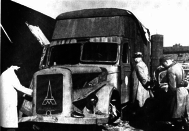
SS operatives at Chelmno began the systematic murder of Jewish prisoners using gas vans on December 8, 1941, marking the first use of poison gas as a method of mass extermination in the Holocaust. The camp, located in a converted manor house near Lodz in occupied Poland, killed between 152,000 and 340,000 people over the next three years, the vast majority of them Jews from the Lodz ghetto and surrounding Warthegau region. Chelmno was the prototype for the industrialized killing that defined the Nazi genocide. The gas vans were modified cargo trucks with sealed rear compartments. Engine exhaust was piped into the enclosed space through a specially fitted hose. Victims were told they were being transported to labor camps and ordered into the vehicles. The drive to mass graves in the nearby Rzuchow forest took approximately ten minutes, long enough for the carbon monoxide to kill everyone inside. SS guards at the burial site then forced a small group of Jewish prisoners to unload and bury the bodies. Chelmno operated differently from the death camps that followed at Belzec, Sobibor, Treblinka, and Auschwitz-Birkenau. It had no permanent gas chambers, relying entirely on mobile vans. The camp was small, employing only about 120 SS and police personnel. Its isolation and primitive methods meant that knowledge of its operations spread slowly. The first confirmed report reached the West through the testimony of two escapees, Mordechai Podchlebnik and Szymon Srebrnik, though Allied governments were slow to act on the information. The camp was dismantled in 1944 and 1945 as Soviet forces advanced, and the SS attempted to destroy evidence by exhuming and burning bodies. Only a handful of survivors lived to testify at postwar trials. Chelmno's significance in Holocaust history lies in its chronological position: it was where the Nazis crossed from persecution and sporadic killing to the systematic, industrialized extermination of an entire people.
December 8, 1941
85 years ago
Key Figures & Places


What Else Happened on December 8
Northern Wei cavalry crushed the Later Yan army at the Battle of Canhe Slope, executing thousands of prisoners to solidify their dominance over northern China. …
Du Fu walked back into Chang'an two years after running for his life. The city had fallen to rebels in 755, forcing the greatest poet of the Tang Dynasty to fle…
Louis the Stammerer ascended to the West Frankish throne at Compiègne, securing the Carolingian hold on a realm fracturing under Viking raids and noble rebellio…
The horses came at dawn near Oszmiana, and within hours over 3,000 Lithuanian soldiers lay dead in the snow. Uncle against nephew — Švitrigaila controlled the G…
Ahmad ibn Abi Jum'ah issued a bold fatwa on December 8, 1504, permitting forcibly converted Muslims in Spain to relax strict ritual observances under Christian …
A Jesuit priest stood in thick Brazilian forest 15 miles from São Paulo and declared a village. Father Miguel de Almeida named it Nossa Senhora da Conceição dos…
Talk to History
Have a conversation with historical figures who witnessed this era. Ask questions, explore perspectives, and bring history to life.