

Whale Attacks Essex: Moby Dick's Real Inspiration
An enormous sperm whale, estimated at 85 feet long, rammed the whaling ship Essex twice in the open Pacific, staving in her bow planks and sinking the 238-ton vessel in a matter of minutes. The attack, 2,000 miles west of South America, left twenty crew members adrift in three small whaleboats with minimal provisions, beginning one of the most harrowing survival ordeals in maritime history and providing Herman Melville with the factual foundation for Moby-Dick. The Essex, commanded by Captain George Pollard Jr., had departed Nantucket in August 1819 on a whaling voyage expected to last two to three years. On the morning of November 20, 1820, first mate Owen Chase was supervising repairs to a damaged whaleboat when he spotted a massive bull sperm whale lying motionless on the surface. The whale suddenly charged the ship, striking the bow with its head. It circled, turned, and struck again with what Chase described as "tenfold fury and vengeance," crushing the bow timbers. The Essex began taking on water immediately and listed to port. The crew salvaged what provisions they could, including 600 pounds of hardtack, 200 gallons of water, and navigational instruments, and set out in three 20-foot whaleboats. Pollard wanted to sail for the nearest land, the Marquesas Islands, roughly 1,200 miles to the west. Chase and the crew argued against it, fearing rumored cannibals on those islands, an irony that would become grimly apparent. They chose instead to sail south and east toward South America, a route of over 3,000 miles against the prevailing winds. What followed was 95 days of starvation, dehydration, and escalating horror. Rations ran out. Men began dying. The survivors, driven by desperation, resorted to cannibalism, first eating those who had died of natural causes, then drawing lots to determine who would be killed so the others might live. Pollard's young cousin, Owen Coffin, drew the short lot and was shot by another crewman.
November 20, 1820
206 years ago
Key Figures & Places
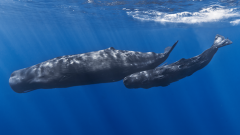
Sperm whale
Wikipedia

Herman Melville
Wikipedia

South America
Wikipedia
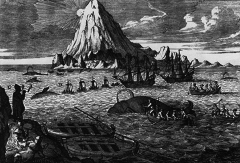
whaling
Wikipedia
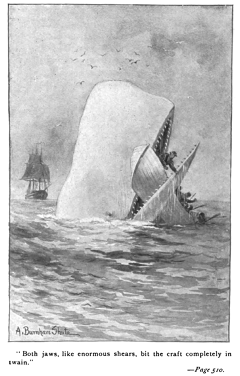
Moby-Dick
Wikipedia
Nantucket, Massachusetts
Wikipedia
Whaleship Essex
Wikipedia

Sperm whale
Wikipedia
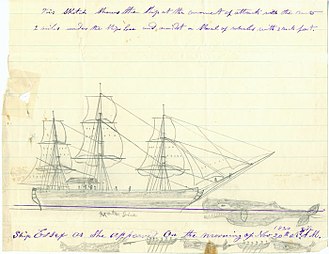
Essex (whaleship)
Wikipedia

Whaling
Wikipedia

Nantucket
Wikipedia

Herman Melville
Wikipedia

Moby-Dick
Wikipedia

Antofagasta
Wikipedia

Canibalismo
Wikipedia
1851
Wikipedia
What Else Happened on November 20
A soldier, not a senator. Diocletian climbed from humble Dalmatian origins — possibly born a slave's son — to command Rome's entire imperial machine in 284 AD. …
The deal Emperor Suzong struck was brutal: let the Huihe soldiers loot Luoyang for three days after victory. Three days. A city of hundreds of thousands, handed…
Emperor Henry VI stormed Palermo on Christmas Day, seizing the Sicilian crown through his wife Constance's claim. The conquest united the Holy Roman Empire with…
Henry VI, Holy Roman Emperor, conquered Palermo and claimed the Kingdom of Sicily through his wife Constance, uniting it with the Holy Roman Empire. The conques…
John the Fearless, Duke of Burgundy, signed a truce with Louis of Valois, Duke of Orléans, on November 20, 1407, only to order Louis's assassination three days …
John the Fearless, Duke of Burgundy, and Louis of Valois, Duke of Orleans, agreed to a formal truce brokered by the Duke of Berry to end their escalating rivalr…
Talk to History
Have a conversation with historical figures who witnessed this era. Ask questions, explore perspectives, and bring history to life.