

Articles of Confederation Adopted: America's First Constitution
The Continental Congress finally approved the Articles of Confederation after sixteen months of fierce debate, establishing the first written constitution for the United States. This fragile framework granted states supreme power while stripping the central government of authority to tax or regulate trade, a structural flaw that would eventually force the nation to draft a new Constitution.
November 15, 1777
249 years ago
Key Figures & Places

American Revolutionary War
Wikipedia
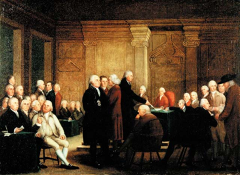
Continental Congress
Wikipedia
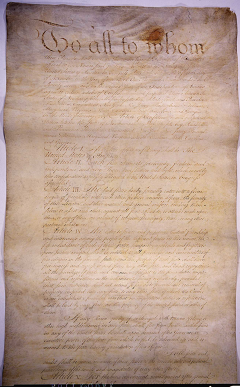
Articles of Confederation
Wikipedia

American Revolutionary War
Wikipedia

Continental Congress
Wikipedia

Articles of Confederation
Wikipedia

Philadelphia
Wikipedia

Second Continental Congress
Wikipedia

Constitutional Convention (United States)
Wikipedia

History of the United States
Wikipedia
What Else Happened on November 15
Justin II ascended the Byzantine throne immediately following the death of his uncle, Justinian I. He inherited a treasury drained by excessive building project…
en Constantinopla (Imperio bizantino) Justino II sucede a su tío, Justiniano I, como emperador.
Oswiu of Northumbria crushed the Mercian army at the Battle of the Winwaed, killing King Penda as his forces retreated through flooded marshes. This decisive vi…
Heinrich I. von Müllenark wird Erzbischof von Köln.
Swiss peasants crush Leopold I's heavy cavalry at Morgarten, shattering Habsburg ambitions to dominate the region. This decisive victory forces Austria to recog…
Swiss confederates ambushed Leopold I’s Austrian cavalry in a narrow pass at Morgarten, using boulders and halberds to shatter the heavy knights. This victory s…
Talk to History
Have a conversation with historical figures who witnessed this era. Ask questions, explore perspectives, and bring history to life.