

Tacoma Narrows Collapses: Engineering Hubris Exposed
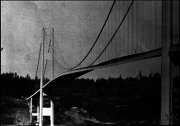
The Tacoma Narrows Bridge twisted violently in a 42-mile-per-hour wind on November 7, 1940, its roadbed pitching at angles exceeding 45 degrees before the main span tore apart and plunged into Puget Sound. The collapse, captured on film, produced one of the most famous engineering failure recordings in history. The only casualty was a cocker spaniel named Tubby, trapped in a car abandoned on the heaving deck. The bridge had earned the nickname "Galloping Gertie" within days of its July 1 opening because its roadbed visibly undulated in even moderate winds. Drivers reported a roller-coaster sensation. State engineers tried hydraulic dampers and tie-down cables, but nothing stopped the oscillations. Leonard Coatsworth, the last person to cross before the collapse, abandoned his car and crawled on hands and knees to safety as the roadbed tilted beneath him. The failure was caused by aeroelastic flutter, a self-reinforcing interaction between wind and structure. The design by Leon Moisseiff used an extremely shallow plate-girder deck only eight feet deep across a span of 2,800 feet, making it the most flexible suspension bridge ever built. Wind flowing across the deck created vortices that pushed the structure into oscillation. Instead of dampening, the oscillations grew because each twist changed the angle at which wind hit the deck, feeding energy back into the motion. The collapse fundamentally changed bridge engineering. Every major suspension bridge designed afterward incorporated aerodynamic testing, usually with wind tunnel models, and used deep stiffening trusses or box girders to prevent flutter. A replacement bridge with a stiffer, wider deck opened at the same site in 1950. The original's failure, preserved on film and studied in engineering courses worldwide, accomplished more for structural safety in its destruction than most bridges achieve in a century of service.
November 7, 1940
86 years ago
Key Figures & Places


What Else Happened on November 7
The charge sounds almost absurdly mundane — a grain fleet, sitting idle. But that's what brought Athanasius of Alexandria down. Emperor Constantine didn't exile…
The Sixth Ecumenical Council convened in Constantinople under Emperor Constantine IV to resolve the Monothelite controversy over whether Christ had one will or …
Charles the Simple of West Francia and Henry the Fowler of East Francia signed the Treaty of Bonn on November 7, 921, formally recognizing the Rhine as the bord…
Fifty thousand Ming soldiers. Ambushed. Gone — in a single night near the marshes of Tốt Động. Lê Lợi's rebels had spent years bleeding in the mountains of Lam …
A 280-pound rock fell from a clear sky and buried itself six feet into a wheat field. A young boy watched it hit. Villagers rushed out, chipped off pieces as so…
Christopher Columbus returned to Spain from his fourth and final voyage, broken in health and stripped of most of his titles. He had discovered Central American…
Talk to History
Have a conversation with historical figures who witnessed this era. Ask questions, explore perspectives, and bring history to life.