Hungary Revolts Against Soviets: Uprising Crushed
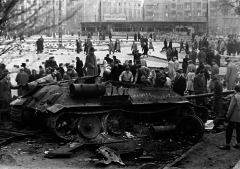
Soviet tanks rolled into Budapest before dawn on November 4, 1956, and within days the most serious challenge to Communist rule in Eastern Europe was crushed. Seventeen Soviet divisions, roughly 150,000 troops and 2,500 tanks, attacked a city whose defenders included factory workers with Molotov cocktails, students with captured rifles, and Hungarian army units that had defected to the revolution. The uprising had begun twelve days earlier as a student demonstration that exploded into a nationwide revolt. On October 23, a crowd of 200,000 gathered at Parliament demanding political reform. When State Security Police opened fire on protesters at Radio Budapest, the revolution ignited. Workers' councils seized factories, political prisoners were freed, and secret police officers were hunted through the streets. Imre Nagy, the reform-minded Communist installed as prime minister during the initial unrest, moved further than Moscow could tolerate. He announced Hungary's withdrawal from the Warsaw Pact and declared neutrality. Soviet leaders, initially divided on how to respond, concluded that allowing one satellite state to leave the alliance would trigger a chain reaction. The decision to invade was finalized on October 31. The Hungarian resistance fought fiercely but hopelessly. Armed civilians ambushed Soviet columns in narrow Budapest streets, knocking out tanks with improvised explosives. Organized combat lasted until November 10, though sporadic resistance continued for weeks. Over 2,500 Hungarians were killed, and roughly 200,000 fled the country in the largest refugee crisis in Cold War Europe. The Western powers, distracted by the simultaneous Suez Crisis, offered verbal condemnation and nothing more. The crushing of Hungary demonstrated that the Soviet Union would use overwhelming military force to maintain its empire, a lesson that deterred similar uprisings for more than three decades.
November 4, 1956
70 years ago
Key Figures & Places

What Else Happened on November 4
Riots erupt in Constantinople as citizens, enraged by Emperor Anastasius' removal of Chalcedonian patriarchs and liturgical shifts, attempt to crown Areobindus …
The water rose so fast that horses drowned inside their stables. Giovanni Villani watched Florence drown in 1333, scribbling furiously as the Arno swallowed bri…
Paganino Doria's Genoese fleet annihilated the Venetian navy under Niccolò Pisani at the Battle of Sapienza on November 4, 1354, capturing virtually every Venet…
Joan of Arc led a successful assault on Saint-Pierre-le-Moutier despite being initially repulsed and nearly abandoned by her own troops. According to her compan…
Christopher Columbus reached the Leeward Islands on his second voyage, bringing 17 ships and 1,200 colonists to establish permanent European settlements in the …
She'd traveled for months, survived seasickness, and didn't even speak English. Catherine of Aragon finally met Arthur Tudor in November 1501 — a 15-year-old Sp…
Talk to History
Have a conversation with historical figures who witnessed this era. Ask questions, explore perspectives, and bring history to life.