
Black Monday 1929: Wall Street Crash Deepens
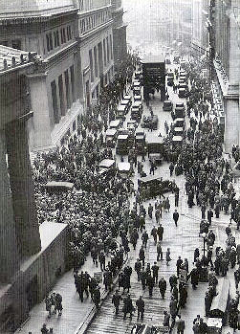
The New York Stock Exchange lost nearly 13 percent of its value on October 28, 1929, a day the newspapers christened "Black Monday," as the fragile calm that had followed Thursday's initial crash dissolved into unrestricted panic selling. More than 9.2 million shares traded, triple the normal volume, and the Dow Jones Industrial Average fell 38.33 points, the largest single-day point decline in its history at that time. The worst, however, was still one day away. Thursday's crash had been partially contained when a consortium of leading bankers, organized by Thomas Lamont of J.P. Morgan and Company, pooled funds to buy major stocks and stabilize prices. Over the weekend, bankers, brokers, and government officials issued reassuring statements. President Herbert Hoover declared that "the fundamental business of the country" was sound. The statements proved disastrously premature. When the market opened Monday morning, sell orders from across the country overwhelmed the trading floor. Unlike Thursday, no banking consortium materialized to provide support. The bankers had concluded over the weekend that further intervention would be throwing good money after bad. Margin calls, demands from brokers that investors deposit additional cash to cover their leveraged positions, forced thousands of small investors to sell at any price, driving stocks further down in a self-reinforcing spiral. The carnage was broad-based. Blue-chip stocks like General Electric and U.S. Steel fell alongside speculative issues. The ticker tape ran hours behind actual trades, meaning investors had no way to know what their holdings were worth in real time. Crowds gathered outside the Exchange on Broad Street. Police reinforcements were deployed. Inside the trading floor, brokers shouted themselves hoarse trying to execute sell orders. Monday's losses wiped out an estimated $14 billion in market value in a single session. But the rout was not over. Tuesday, October 29, would bring even heavier selling, with 16.4 million shares traded and losses that would push the market down nearly 25 percent in two days combined. Together, Black Monday and Black Tuesday triggered the chain reaction of bank failures, credit contraction, and unemployment that became the Great Depression, the worst economic catastrophe in modern Western history.
October 28, 1929
97 years ago
Key Figures & Places
What Else Happened on October 28
The Praetorian Guard forced Emperor Nerva to adopt Trajan as his heir. Nerva was 66 and childless. The Guard had murdered his predecessor. They wanted a militar…
Maxentius declared himself Roman Emperor after his father's failed comeback attempt. The Praetorian Guard backed him. Rome's citizens backed him. The actual emp…
Constantine marched his outnumbered army across the Milvian Bridge over the Tiber River on October 28, 312 AD, and routed the forces of his rival Maxentius in a…
Visigothic forces sacked Braga, capital of the Suevi kingdom in northwest Iberia. They burned the city's churches to the ground. The Suevi had converted to Cath…
Byzantine general Michael Bourtzes scaled Antioch's walls at night with a small force and seized two towers. The city had been in Arab hands for 340 years. Bour…
Byzantine forces recaptured Antioch in 969 after 333 years of Arab rule. Emperor Nikephoros II Phokas sent his best general, Michael Bourtzes, who climbed the w…
Talk to History
Have a conversation with historical figures who witnessed this era. Ask questions, explore perspectives, and bring history to life.