La Rochelle Falls: Richelieu Crushes Huguenot Fortress
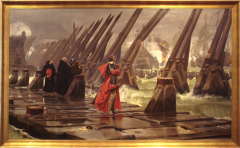
The Huguenot fortress city of La Rochelle surrendered to Cardinal Richelieu's royal forces on October 28, 1628, after a fourteen-month siege that starved the population from 27,000 to fewer than 5,000 survivors. The fall of La Rochelle destroyed the last major Protestant military stronghold in France and consolidated the absolute authority of the French crown over its territory, making Richelieu's victory one of the defining moments of early modern European statecraft. La Rochelle had been the beating heart of French Protestantism for nearly a century. The city's fortifications, its access to the Atlantic, and its alliance with England made it virtually independent of royal authority. The Huguenots used it as both a spiritual capital and a military base, and previous attempts to subdue it had failed. Richelieu, chief minister to King Louis XIII and the most formidable political mind in Europe, recognized that no centralized French state could exist while La Rochelle remained defiant. Richelieu's siege was a masterpiece of engineering and patience. He ordered the construction of a massive seawall across the harbor mouth, a stone and wooden barrier nearly a mile long, to prevent English ships from resupplying the city by sea. The Duke of Buckingham, commanding an English relief force, attempted to break the blockade but failed catastrophically, losing thousands of men on the nearby Ile de Re before retreating. A second English fleet arrived in September 1628 but could not breach the seawall. Inside La Rochelle, conditions deteriorated into horror. The defenders ate leather, boiled their shoes, and stripped the city of anything remotely edible. Starvation and disease killed thousands. Mayor Jean Guiton reportedly placed a dagger on the council table and declared he would kill anyone who spoke of surrender, but by October the city had no choice. When the gates finally opened, Richelieu's troops found a ghost town. Richelieu treated the survivors with surprising leniency, allowing them to retain their Protestant faith but stripping the city of its fortifications and political autonomy. The Peace of Alais, signed the following year, extended this model to all French Huguenots: freedom of worship was preserved, but the right to maintain fortified cities and private armies was eliminated. Richelieu had broken Protestant military power in France without outlawing Protestantism itself, a distinction that held until Louis XIV revoked the Edict of Nantes in 1685.
October 28, 1628
398 years ago
Key Figures & Places
What Else Happened on October 28
The Praetorian Guard forced Emperor Nerva to adopt Trajan as his heir. Nerva was 66 and childless. The Guard had murdered his predecessor. They wanted a militar…
Maxentius declared himself Roman Emperor after his father's failed comeback attempt. The Praetorian Guard backed him. Rome's citizens backed him. The actual emp…
Constantine marched his outnumbered army across the Milvian Bridge over the Tiber River on October 28, 312 AD, and routed the forces of his rival Maxentius in a…
Visigothic forces sacked Braga, capital of the Suevi kingdom in northwest Iberia. They burned the city's churches to the ground. The Suevi had converted to Cath…
Byzantine general Michael Bourtzes scaled Antioch's walls at night with a small force and seized two towers. The city had been in Arab hands for 340 years. Bour…
Byzantine forces recaptured Antioch in 969 after 333 years of Arab rule. Emperor Nikephoros II Phokas sent his best general, Michael Bourtzes, who climbed the w…
Talk to History
Have a conversation with historical figures who witnessed this era. Ask questions, explore perspectives, and bring history to life.