Israel-Jordan Peace Treaty Signed by Rabin
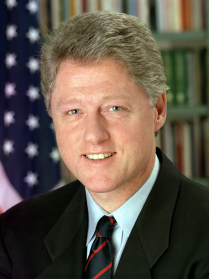
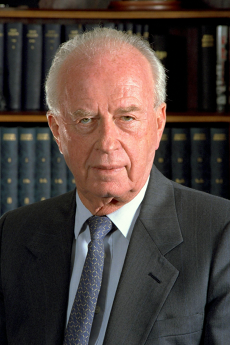
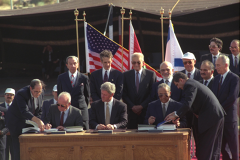
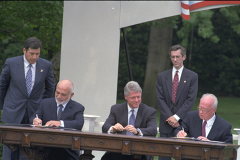
Israeli Prime Minister Yitzhak Rabin and Jordanian Prime Minister Abdel Salam Majali signed a formal peace treaty at a ceremony in the Arava Valley on the border between their two countries on October 26, 1994, with President Bill Clinton as witness. Jordan became only the second Arab state, after Egypt in 1979, to make peace with Israel, and the treaty marked the high point of the Oslo-era optimism that the Middle East's longest-running conflicts might finally be resolved through negotiation. The treaty was the public culmination of decades of secret contact. Jordan and Israel had maintained a covert relationship since the 1960s, with King Hussein meeting Israeli leaders privately on numerous occasions. The two countries shared intelligence, coordinated water management along the Jordan River, and maintained an unspoken non-aggression understanding even during the wars of 1967 and 1973. What the treaty formalized was largely what both sides had already been practicing quietly. The agreement established full diplomatic relations, settled border disputes dating to 1948, allocated water rights from the Jordan and Yarmouk rivers, and opened provisions for tourism, trade, and security cooperation. Jordan recovered small parcels of territory that Israel had occupied, and Israel agreed to respect Jordan's special custodial role over Muslim holy sites in Jerusalem, a point of immense symbolic importance for the Hashemite monarchy. King Hussein and Rabin, who had developed a genuine personal rapport, presented the treaty as proof that peace between Arabs and Israelis was achievable. The signing ceremony was deliberately held in the desert at the border crossing, with the barren landscape serving as a backdrop for the handshakes and embraces that television cameras broadcast worldwide. The broader peace that Rabin and Hussein envisioned did not materialize. Rabin was assassinated by an Israeli extremist in November 1995, and the Oslo process between Israel and the Palestinians gradually collapsed over the following decade. The Israel-Jordan treaty itself has endured, though it remains unpopular with much of the Jordanian public and has produced far less economic cooperation than its architects hoped. Jordan remains one of only two Arab states with a formal peace agreement with Israel, a fact that underscores both the treaty's durability and its isolation.
October 26, 1994
32 years ago
Key Figures & Places
What Else Happened on October 26
Roman soldiers arrested Demetrius during Emperor Diocletian's persecution of Christians. He was a deacon in Thessaloniki, secretly baptizing converts. They lock…
The earthquake hit Constantinople at dawn. The city walls cracked. The aqueduct collapsed. Thousands died in their homes. Emperor Leo III was in the palace when…
The brothers Asen and Peter launched their rebellion against Byzantine rule during the feast of St. Demetrius, cleverly using the saint's celebration to rally l…
John VI Kantakouzenos proclaimed himself Byzantine Emperor at Didymoteicho, starting a six-year civil war. Emperor Andronikos III had just died. His son was nin…
Tvrtko I crowned himself king of Bosnia on October 26, 1377 in a monastery near his capital. He claimed descent from Serbian royalty that didn't exist. The crow…
Charles V's coronation in 1520 made him Holy Roman Emperor at 20. He already ruled Spain, the Netherlands, Austria, Naples, and most of the Americas. His empire…
Talk to History
Have a conversation with historical figures who witnessed this era. Ask questions, explore perspectives, and bring history to life.