Great Chicago Fire: A City Rebuilt From Ashes
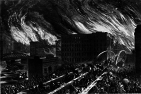
Flames leaped from a barn on DeKoven Street at roughly 9:00 p.m. on October 8, 1871, and by the time rain finally extinguished the last embers two days later, three and a half square miles of Chicago had been reduced to ash. The Great Chicago Fire killed approximately 300 people, left 100,000 homeless — a third of the city's population — and destroyed over 17,000 buildings, including the entire central business district. The city was a tinderbox waiting for a spark. Chicago in 1871 was built almost entirely of wood — houses, sidewalks, roads, even the railroad infrastructure. A severe drought through the summer had left the region parched; the city had received barely an inch of rain since July. The fire department, which had fought nearly thirty fires in the week before October 8, was exhausted. When a watchman at the courthouse spotted the DeKoven Street blaze, he sent firefighters to the wrong location — a mistake that gave the fire a critical head start. The traditional story blames Catherine O'Leary's cow for kicking over a lantern, but the reporter who wrote that account, Michael Ahern of the Chicago Republican, admitted in 1893 that he had fabricated the tale. The actual cause has never been determined. Some evidence suggests a group of men gambling in the barn knocked over a lamp; other theories point to a stray ember from an earlier fire. What is certain is how quickly the fire became unstoppable. Strong southwest winds drove burning embers across blocks of wooden rooftops, igniting neighborhoods far ahead of the fire's ground-level advance. The fire jumped the south branch of the Chicago River, then the main branch, consuming everything in its path — hotels, churches, the courthouse, the waterworks that supplied the city's fire hydrants. When the waterworks burned, firefighters lost water pressure entirely. The destruction created a blank canvas. Within two years, over $40 million in construction was underway. Architects and engineers, freed from the constraints of the old city, pioneered fireproof steel-frame construction and invented the skyscraper. William Le Baron Jenney's Home Insurance Building, completed in 1885, used a structural steel skeleton that made tall buildings feasible. The architectural innovation born from Chicago's destruction shaped urban skylines worldwide.
October 8, 1871
155 years ago
Key Figures & Places

What Else Happened on October 8
Constantine defeated his co-emperor Licinius at Cibalae in 314, killing 20,000 of his soldiers and seizing his European territories in a single afternoon. They'…
Constantine I crushed the forces of Licinius at the Battle of Cibalae, forcing his rival to cede the Balkan provinces. This victory split the Roman Empire into …
The Council of Chalcedon opened in 451 with 520 bishops debating whether Christ had one nature or two. Emperor Marcian called the council to resolve the questio…
The Council of Chalcedon opened in 451 with 520 bishops packed into the church of Saint Euphemia, arguing over whether Christ had one nature or two. Emperor Mar…
Louis the Younger crushed the forces of his uncle, Charles the Bald, at the Battle of Andernach, halting West Frankish expansion into the Rhineland. This decisi…
Dmitar Zvonimir was crowned King of Croatia in 1075 with a crown sent by Pope Gregory VII, making Croatia a formal ally of Rome against Byzantium. The ceremony …
Talk to History
Have a conversation with historical figures who witnessed this era. Ask questions, explore perspectives, and bring history to life.