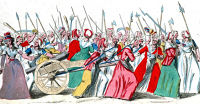
Women Storm Versailles: King Dragged Back to Paris
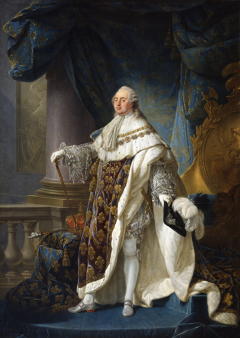
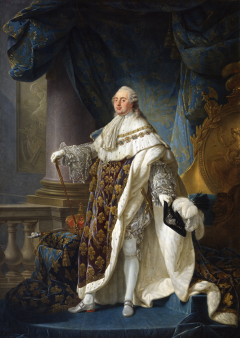
Thousands of women armed with pikes, muskets, and kitchen knives marched twelve miles through the rain from Paris to the royal palace at Versailles on October 5, 1789, demanding bread and dragging the king back to his capital. The Women's March on Versailles was the moment the French Revolution stopped being a philosophical debate about rights and became an irreversible confrontation between the people and the monarchy. The immediate trigger was hunger. A bread shortage had gripped Paris for weeks, and the price of a four-pound loaf had climbed to levels that consumed most of a laborer's daily wage. Women who spent hours in bakery lines, only to find shelves empty, were furious. On the morning of October 5, a crowd that began at the central markets swelled as it moved through the streets, absorbing market women, laundresses, seamstresses, and prostitutes. They seized weapons from the Hôtel de Ville and turned toward Versailles. The march was both spontaneous and coordinated. Revolutionary agitators, possibly including agents of the Duke of Orléans, helped organize the column, but the rage was genuine and required no manipulation. The Marquis de Lafayette, commander of the National Guard, initially tried to prevent his troops from joining the marchers, then reluctantly led them to Versailles to maintain some semblance of order. The women arrived at the palace soaking wet and enraged. A delegation met Louis XVI, who promised to release grain stores to Paris. The crowd was not satisfied. Before dawn on October 6, a group of marchers breached the palace gates and stormed toward Marie Antoinette's apartments. Two royal bodyguards were killed and their heads mounted on pikes. Lafayette managed to calm the crowd by presenting the queen on a balcony, where she bowed to the mob in a moment of extraordinary nerve. Louis XVI agreed to relocate to the Tuileries Palace in Paris, effectively becoming a prisoner of the Revolution. The royal family's carriage departed Versailles surrounded by the triumphal crowd, some carrying the bodyguards' heads ahead of the procession. The king never returned. Within four years, both he and Marie Antoinette would be dead on the guillotine.
October 5, 1789
237 years ago
Key Figures & Places

What Else Happened on October 5
An Egyptian border guard opened fire on Israeli tourists at Ras Burqa in the Sinai in 1985, killing seven, including four children. He emptied three rifle magaz…
Three kings led the invasion of Iberia in 456: Theodoric II of the Visigoths, Chilperic I of the Burgundians, and Gondioc of the Franks. They were following ord…
Heraclius sailed from Carthage to Constantinople in 610 to overthrow Emperor Phocas, who'd murdered his way to the throne eight years earlier. Heraclius's ships…
Heraclius was crowned Byzantine Emperor in 610 after sailing from Carthage to Constantinople and overthrowing Phocas, who'd murdered the previous emperor. Phoca…
Pope Stephen IV traveled to Reims to crown Louis the Pious in 816, even though Louis had already crowned himself three years earlier. The Pope needed Frankish m…
The Fourth Council of Constantinople convened to settle the Photian Schism. Patriarch Photius had replaced Ignatius after Emperor Michael III forced Ignatius ou…
Talk to History
Have a conversation with historical figures who witnessed this era. Ask questions, explore perspectives, and bring history to life.