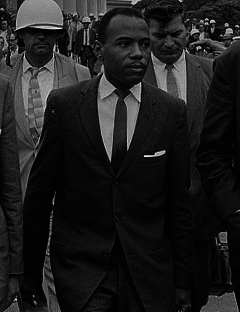
Meredith Enrolls at Ole Miss: Segregation Shattered
James Meredith walked into the Lyceum building at the University of Mississippi on September 30, 1962, to register for classes, and a riot erupted that required 30,000 federal troops to suppress. The integration of Ole Miss was the most violent confrontation of the civil rights movement until that point, leaving two people dead and hundreds injured. Meredith, a twenty-nine-year-old Air Force veteran, had applied to the university in January 1961 and been rejected solely because of his race. The NAACP Legal Defense Fund took his case, and after sixteen months of legal battles, the Supreme Court ordered his admission. Governor Ross Barnett, a segregationist Democrat, personally blocked Meredith's enrollment on three separate occasions, declaring on statewide television that Mississippi would never surrender to the forces of integration. President John F. Kennedy attempted to negotiate with Barnett by phone, offering political cover in exchange for compliance. Barnett, playing to his base while secretly assuring Kennedy he would eventually yield, kept moving the goalposts. On September 30, Kennedy federalized the Mississippi National Guard and dispatched 500 U.S. Marshals to escort Meredith onto campus. The riot began that evening when a mob of over 2,000 students, Klansmen, and segregationists from across the South attacked the marshals with bricks, bottles, guns, and Molotov cocktails. The marshals held their positions around the Lyceum using tear gas but were steadily beaten back. A French journalist, Paul Guihard, was shot in the back and killed. A local bystander, Ray Gunter, was also fatally shot. Over 200 marshals were wounded, 28 by gunfire. Kennedy ordered Army troops to Oxford early on October 1. By dawn, 20,000 soldiers occupied the campus and town. Meredith registered for classes that morning, attended his first lecture in American history, and completed the semester under constant military escort. Meredith graduated from Ole Miss in August 1963 with a degree in political science. The university that had required an army to admit him now has a civil rights monument on the campus and named a building in his honor. Meredith's solitary act of defiance forced the federal government to demonstrate, for the second time in five years after Little Rock, that it would use military force to enforce constitutional rights.
September 30, 1962
64 years ago
Key Figures & Places
What Else Happened on September 30
Fred Flintstone's feet were the engine and the brakes. The Flintstones premiered on ABC on September 30, 1960, animated by Hanna-Barbera as the first primetime …
Theoderic the Great had already beaten Odoacer once, at the Isonzo River. Odoacer retreated to Verona in 489, regrouped, and met the Ostrogoths again under the …
The Umayyad general Asad ibn Abdallah al-Qasri pushed his army deep into Central Asia in 737, further than any Arab force had gone. The Turgesh didn't meet him …
A magnitude 7.7 earthquake struck the Caucasus mountains under Seljuk rule on September 30, 1139, leveling cities and killing an estimated 230,000 to 300,000 pe…
At Morlaix in 1342, a small English force of around 1,500 men faced a French army three times its size — and won, by digging hidden trenches the night before ba…
He'd been exiled, disinherited, and given just enough rope to hang himself. Henry Bolingbroke took that rope and used it to strangle a king instead. Richard II …
Talk to History
Have a conversation with historical figures who witnessed this era. Ask questions, explore perspectives, and bring history to life.