

First American Newspaper Published in 1690
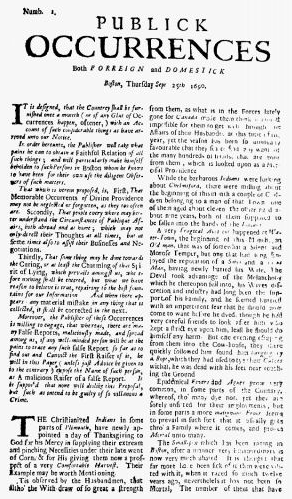
America's first newspaper lasted exactly one issue. On September 25, 1690, printer Benjamin Harris published Publick Occurrences Both Forreign and Domestick in Boston, a four-page broadsheet that the colonial government immediately suppressed. The paper's entire print run was confiscated and destroyed, but its brief existence established a principle that authorities would spend the next century trying to contain. Harris was an experienced troublemaker. He had published a radical anti-Catholic newspaper in London called Domestick Intelligence before fleeing to Boston in 1686 to escape prosecution. Publick Occurrences was intended as a monthly publication, and Harris left the fourth page blank so subscribers could add their own news before passing it along. The content was a mix of war reporting, local news, and gossip. Harris covered King William's War against the French and their Native American allies, reported on a suicide in Watertown, described a smallpox outbreak, and included an item alleging that the king of France had an affair with his daughter-in-law. The colonial authorities were less concerned with the scandalous content than with the fact that Harris had published without a license. Four days after publication, the Governor and Council of Massachusetts Bay Colony banned the paper, declaring that it had been printed "without the least Privity or Countenance of Authority" and contained "Reflections of a very high nature." Every available copy was ordered destroyed. Harris never published another issue. The suppression of Publick Occurrences reflected a governing class that viewed printing as a privilege to be controlled, not a right to be exercised. Licensed newspapers would not appear in America until 1704, when John Campbell began publishing the Boston News-Letter with the government's explicit permission. The tension between press freedom and government control that Publick Occurrences exposed would define American journalism for the next three centuries, from the Zenger trial of 1735 through the ratification of the First Amendment in 1791.
September 25, 1690
336 years ago
Key Figures & Places
What Else Happened on September 25
The Roman Senate reclaimed the rare authority to choose an emperor by proclaiming the elderly senator Marcus Claudius Tacitus after a two-month interregnum foll…
The Senate hadn't chosen an emperor in decades — power had passed through assassination, military coup, and dynastic succession. But in 275, with Aurelian dead …
Saint Fermin of Pamplona met his end by beheading in Amiens after traveling through Gaul to spread Christianity. His martyrdom transformed him into the patron s…
Muhammad al-Nafs al-Zakiyya — 'the Pure Soul' — had been expected to be the Mahdi since childhood, a man his own followers believed was destined to restore righ…
King Harold II of England crushed Harald Hardrada's Norwegian invasion at Stamford Bridge on September 25, 1066, killing the Norse king and annihilating his arm…
King Harold Godwinson’s forces crushed the army of Harald Hardrada at Stamford Bridge, ending the centuries-long era of Viking incursions into England. By elimi…
Talk to History
Have a conversation with historical figures who witnessed this era. Ask questions, explore perspectives, and bring history to life.