

Black Wednesday: Pound Crashes Out of European Exchange
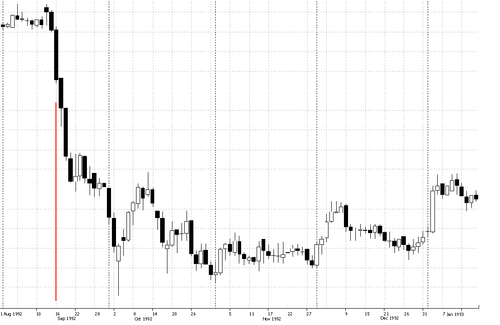
The Bank of England spent an estimated 3.3 billion pounds in a single day trying to prop up the value of sterling on September 16, 1992, raising interest rates twice in a matter of hours from 10 percent to 12 percent and then to 15 percent, before conceding defeat and withdrawing the pound from the European Exchange Rate Mechanism. Black Wednesday, as the markets immediately dubbed it, humiliated the Conservative government of John Major, made George Soros over a billion dollars in a single trade, and fundamentally altered Britain’s relationship with European monetary integration. Britain had joined the ERM in October 1990, pegging the pound to the Deutsche Mark within a narrow band. The system was designed to reduce currency volatility and prepare European economies for eventual monetary union. But Britain entered at a rate many economists considered too high, and the country was sliding into recession. Maintaining the peg required keeping interest rates elevated even as unemployment climbed and businesses contracted, a politically toxic combination. Currency speculators, led by Soros’s Quantum Fund, recognized that the fundamentals did not support the pound’s exchange rate and bet massively against it. Soros built a short position of roughly 10 billion pounds, borrowing sterling to sell for Deutsche Marks in the expectation that the pound would be devalued. When the Bank of England began intervening on September 16, buying pounds with its foreign currency reserves, the speculators simply sold into the buying, absorbing the central bank’s ammunition. The interest rate increases, announced in rapid succession during a chaotic trading day, failed to convince the markets. By 7:30 p.m., Chancellor Norman Lamont appeared outside the Treasury and announced Britain’s withdrawal from the ERM and the reversal of the interest rate hikes. The pound fell 15 percent against the Mark and 25 percent against the dollar over the following weeks. The political damage was permanent: the Conservative Party’s reputation for economic competence, cultivated since the Thatcher era, was destroyed overnight. The episode also hardened British skepticism toward European monetary projects, a sentiment that contributed to the Brexit vote twenty-four years later.
September 16, 1992
34 years ago
Key Figures & Places
Pound sterling
Wikipedia

European Exchange Rate Mechanism
Wikipedia
German mark
Wikipedia
Black Wednesday
Wikipedia
Speculation
Wikipedia

Black Wednesday
Wikipedia

European Exchange Rate Mechanism
Wikipedia

Especulación (economía)
Wikipedia
Sistema Monetario Europeo
Wikipedia

British
Wikipedia

Italy
Wikipedia
Wechselkursmechanismus
Wikipedia

George Soros
Wikipedia

Soviet Union
Wikipedia

Anglo-Soviet invasion of Iran
Wikipedia

Reza Shah
Wikipedia
Démission
Wikipedia
Verbannung
Wikipedia
Persischer Korridor
Wikipedia
What Else Happened on September 16
Severus II had been handed the western Roman Empire by Galerius, but Maxentius — the son of the retired emperor Diocletian — refused to recognize him and raised…
The Sixth Ecumenical Council condemned Pope Honorius I for heresy, formally excommunicating him decades after his death. This rare rebuke shattered the doctrine…
Owain Glyndŵr accepted the title of Prince of Wales from his followers, igniting a fierce, decade-long rebellion against English rule. This uprising crippled th…
There were 102 passengers crammed onto the Mayflower, but the ship wasn't meant for them — it was a cargo vessel, roughly 100 feet long, still reeking of the wi…
His father died in exile, and he was thirteen years old. James Francis Edward Stuart inherited the Jacobite claim to the British throne on September 16, 1701, o…
Campo Maior was a small Portuguese frontier town of maybe 2,000 people. In 1732, lightning hit the town's armory during a storm. The resulting explosion didn't …
Talk to History
Have a conversation with historical figures who witnessed this era. Ask questions, explore perspectives, and bring history to life.