Perry Wins at Lake Erie: U.S. Controls Great Lakes
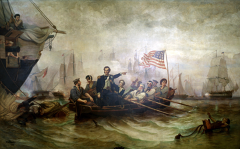
Commodore Oliver Hazard Perry's squadron destroyed the British fleet on Lake Erie on September 10, 1813, winning the most decisive naval engagement of the War of 1812 and seizing control of the Great Lakes for the United States. Perry, just 28 years old, sent his famous dispatch to General William Henry Harrison after the battle: "We have met the enemy and they are ours: two ships, two brigs, one schooner and one sloop." The victory forced the British to abandon Detroit and retreat into Upper Canada, opening the western theater of the war to American advance. Perry had built much of his fleet from scratch at Presque Isle, on the shores of Lake Erie near present-day Erie, Pennsylvania, using green timber cut from the surrounding forests. The shipbuilders, led by master carpenter Noah Brown, constructed two 20-gun brigs, the Lawrence and the Niagara, in roughly three months, an extraordinary feat of wartime construction. Perry manned his vessels with a mixed crew of sailors, soldiers, and frontier militia, many of whom had never served aboard a warship. The battle was fought near Put-in-Bay, off the Bass Islands in western Lake Erie. Perry's flagship, the Lawrence, bore the brunt of British fire and was reduced to a wreck, with 80 percent of her crew killed or wounded. In one of the most celebrated moments in American naval history, Perry transferred his command to the Niagara by rowing an open boat across the battle line under enemy fire, carrying his battle flag inscribed with the dying words of Captain James Lawrence: "Don't Give Up the Ship." Aboard the Niagara, Perry sailed directly through the British line and delivered broadsides that forced the remaining enemy vessels to surrender. The Battle of Lake Erie was the first time in history that an entire British naval squadron surrendered. Perry's victory severed the British supply line to their Native American allies, led by Tecumseh, and enabled Harrison to advance into Canada, where he won the Battle of the Thames a month later. Tecumseh was killed in that engagement, effectively ending the pan-Indian alliance that had threatened American expansion into the Northwest Territory. Control of the Great Lakes, secured at Perry's battle, remained with the United States permanently.
September 10, 1813
213 years ago
Key Figures & Places
What Else Happened on September 10
Bishops across Visigothic Gaul gathered at the Council of Agde to codify forty-seven canons governing church discipline and clerical conduct. By standardizing r…
Pope Urban II opened the first synod at Melfi on September 10, 1089, gathering seventy bishops and twelve abbots to address clerical reform and relations with t…
John the Fearless earned his nickname at the Battle of Nicopolis in 1396, where his reckless cavalry charge contributed to a catastrophic crusader defeat. He su…
Constantinople in 1509 was still recovering from Ottoman conquest when the earth hit it with what survivors called 'The Lesser Judgment Day.' The earthquake — e…
Thomas Wolsey was the son of an Ipswich butcher who became the most powerful man in England after Henry VIII. His investiture as Cardinal in 1515 capped a rise …
English forces crushed the Scottish army at the Battle of Pinkie Cleugh, utilizing superior naval artillery and cavalry to secure a brutal victory. This rout fo…
Talk to History
Have a conversation with historical figures who witnessed this era. Ask questions, explore perspectives, and bring history to life.