United States Named: Congress Makes It Official
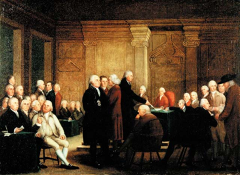
The Continental Congress passed a resolution on September 9, 1776, officially replacing the name "United Colonies" with "United States" in all future documents and declarations, giving the fledgling nation the name it would carry into history. The change came two months after the Declaration of Independence and reflected a growing recognition among the delegates that the former colonies were no longer petitioning for redress within the British system but building an entirely new sovereign entity. A name that emphasized unity and statehood, rather than colonial dependency, was essential to the political identity they were constructing. The delegates who chose the name were meeting in Philadelphia under desperate circumstances. British General William Howe had landed a massive invasion force on Long Island just weeks earlier, and George Washington's Continental Army was in the process of being driven out of New York in a series of humiliating defeats. The Declaration of Independence, with its soaring rhetoric about self-evident truths and inalienable rights, had been signed against the backdrop of a military situation that made independence look far more aspirational than achievable. The name "United States of America" had appeared in the Declaration of Independence itself, but the September 9 resolution formalized its use across all official congressional business. The choice of "states" rather than "provinces," "colonies," or "commonwealths" carried specific political weight: in eighteenth-century usage, a "state" was a sovereign political entity, and the plural "states" emphasized that this was a voluntary union of independent governments rather than a single consolidated nation. That tension between state sovereignty and national unity would drive American political debate for the next two and a half centuries. The name proved remarkably durable. Unlike many revolutionary states, which renamed themselves repeatedly as regimes changed, the United States has carried its original designation through civil war, continental expansion, world wars, and the transformation from a coastal confederation of 3 million people into a global superpower of over 330 million. The two words "United States," chosen by delegates meeting in a city that an enemy army would occupy within the year, became one of the most recognized and consequential names in political history.
September 9, 1776
250 years ago
Key Figures & Places
What Else Happened on September 9
Three Roman legions marched into the Teutoburg Forest in September of 9 AD and never came out. An alliance of six Germanic tribes, led by Arminius, a Romanized …
Constantine I died leaving three sons and an empire — and within weeks, every male relative who might compete with those sons was massacred. The soldiers who di…
Belisarius had 15,000 soldiers and was sailing against the Vandal Kingdom of North Africa, which had sacked Rome 80 years earlier. His commanding officer, the E…
Olaf Tryggvason leaped into the Baltic Sea to escape capture after his fleet fell to a coalition of Scandinavian kings at the Battle of Svolder. This defeat end…
William Rufus seized the English throne following his father’s death, securing his coronation at Westminster Abbey while his elder brother Robert Curthose remai…
Yelü Dashi was supposed to be finished. He'd fled the collapse of the Liao Dynasty with a few hundred followers and ridden west across Central Asia until he fou…
Talk to History
Have a conversation with historical figures who witnessed this era. Ask questions, explore perspectives, and bring history to life.