

Boxer Protocol Signed: China's Sovereignty Crushed
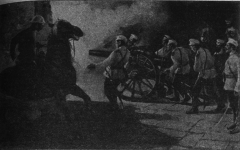
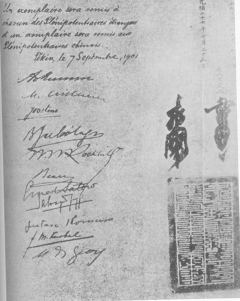
Representatives of eleven foreign nations and the Qing dynasty signed the Boxer Protocol in Beijing on September 7, 1901, formally ending the Boxer Rebellion and imposing on China one of the most humiliating agreements in its history. The protocol required China to pay an indemnity of 450 million taels of silver, roughly $10 billion in modern terms, over 39 years at 4 percent interest, bringing the total obligation to nearly 1 billion taels. China was also forced to allow foreign troops to be stationed permanently between Beijing and the sea, to destroy its coastal fortifications, and to execute or exile officials who had supported the Boxers. The Boxer Rebellion had erupted in 1899 when a secret society known as the Righteous and Harmonious Fists, called "Boxers" by Westerners because of their martial arts practices, launched a violent campaign to drive foreigners and Chinese Christians out of China. The Boxers, who believed that spiritual rituals made them immune to bullets, attacked foreign missionaries, Chinese converts, and eventually besieged the foreign diplomatic legations in Beijing for 55 days. Empress Dowager Cixi, calculating that the Boxers might succeed where her army could not, threw the Qing government's support behind them and declared war on the foreign powers. An international relief force of 20,000 troops from eight nations fought its way from the coast to Beijing and lifted the siege in August 1900. The occupation of the capital was accompanied by widespread looting by foreign soldiers, with Russian, German, British, French, American, and Japanese troops systematically stripping palaces, temples, and private homes of their treasures. German Kaiser Wilhelm II instructed his troops to behave like Huns, a remark that gave the Germans an unwelcome nickname in both world wars. The Boxer Protocol's crushing financial burden and territorial concessions accelerated the decline of the Qing dynasty, which fell in the revolution of 1911. The indemnity payments drained China's treasury for decades, and the permanent foreign military presence in the country became a lasting source of nationalist resentment. The United States later returned a portion of its indemnity share, using the funds to establish scholarships for Chinese students studying in America, a gesture that produced some of the most influential Chinese intellectuals of the twentieth century.
September 7, 1901
125 years ago
Key Figures & Places




What Else Happened on September 7
Roman legions under General Titus breached the walls of Jerusalem, systematically dismantling the Second Temple and ending the Great Jewish Revolt. This destruc…
Louis got the nickname 'the Stammerer' from his contemporaries — and it wasn't metaphorical. He had a pronounced stammer and was reportedly in poor health his e…
The papal election of 1159 produced two claimants simultaneously. The majority of cardinals chose Orlando Bandinelli, who became Alexander III. A minority backe…
Cardinal Rolando Bandinelli's election as Pope Alexander III triggered an immediate split when rivals crowned Cardinal Octaviano Monticelli as Antipope Victor I…
Richard the Lionheart shattered Saladin’s tactical reputation at Arsuf, proving that the Ayyubid army could be defeated in open field combat. By maintaining a d…
Frederick II arrived in the Holy Land already excommunicated by the Pope — the Church had banned him for repeatedly delaying this very trip. So he launched a Cr…
Talk to History
Have a conversation with historical figures who witnessed this era. Ask questions, explore perspectives, and bring history to life.