Edison Patents Kinetoscope: Movies Are Born
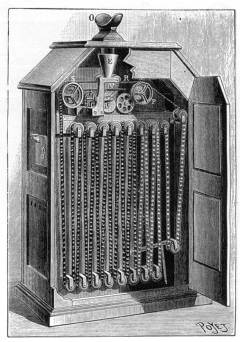
Thomas Edison received a patent for the Kinetoscope on August 31, 1897, securing legal rights to a device that had already transformed public entertainment and launched the motion picture industry. The patent arrived years after the machine was first demonstrated, a delay that would fuel decades of bitter legal battles over who truly invented the movies. The Kinetoscope was primarily the creation of William Kennedy Laurie Dickson, a Scottish inventor working in Edison's laboratory in West Orange, New Jersey. Dickson developed the device between 1889 and 1892, building on Edison's phonograph work and Eadweard Muybridge's sequential photography experiments. The machine used a strip of 35mm celluloid film with perforated edges, run continuously beneath a magnifying lens while illuminated by an electric lamp. A viewer peered through an eyepiece at the top of a wooden cabinet and saw moving images lasting roughly 20 seconds. The first public Kinetoscope parlor opened on April 14, 1894, at 1155 Broadway in New York City, featuring ten machines showing short films of boxing cats, acrobats, and strongmen. The parlors were immediately popular, spreading to cities across America and Europe within months. Customers paid a nickel per film. But the Kinetoscope was a peephole device designed for individual viewing, not projection onto a screen. Edison initially dismissed projection as commercially unviable, believing individual viewers would generate more revenue than audiences sharing a single screen. That miscalculation cost Edison the industry he had helped create. The Lumiere brothers in France developed the Cinematographe, which both filmed and projected movies for audiences, and held their first public screening in Paris in December 1895. Edison scrambled to develop his own projector, the Vitascope, and used his 1897 patent to wage aggressive litigation against competitors. The patent wars consumed the American film industry for over a decade, eventually driving filmmakers from New York and New Jersey to a remote Los Angeles suburb called Hollywood, where Edison's patent enforcement was harder to reach. The entire global film industry, now generating over $100 billion annually, traces its technological origins to a wooden cabinet with a peephole that charged a nickel to watch a cat box.
August 31, 1897
129 years ago
Key Figures & Places
What Else Happened on August 31
Empress Theodora had ruled the Byzantine Empire since 1042, holding the throne first with her sister Zoe and then alone. She was 76. She'd been pulled from a co…
The Haudenosaunee Confederacy — the Iroquois League — bound five nations together under a constitution called the Great Law of Peace. The exact date is disputed…
Al-Kamil ascended to the Ayyubid sultanate, inheriting a realm under siege by the Fifth Crusade. By prioritizing diplomacy over total war, he successfully negot…
Al-Kamil became Sultan of the Ayyubid Empire upon his father Al-Adil's death in 1218, inheriting control of Egypt, Syria, and northern Mesopotamia at a moment w…
King Håkon V Magnusson shifted the Norwegian capital from Bergen to Oslo, consolidating his power in the eastern territories. This move permanently altered the …
A massive earthquake estimated between 8.8 and 9.4 magnitude struck Chile's Atacama Region around 1420, generating a trans-Pacific tsunami that reached the coas…
Talk to History
Have a conversation with historical figures who witnessed this era. Ask questions, explore perspectives, and bring history to life.