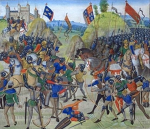
Crecy: English Longbow Defeats French Knights
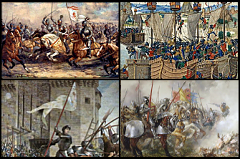
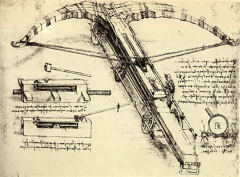
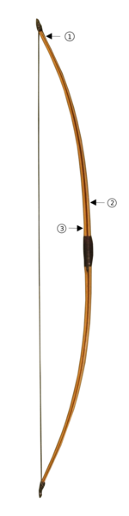
French knights in full plate armor charged uphill into a storm of English arrows at Crecy on August 26, 1346, and the medieval world's understanding of warfare changed forever. By nightfall, thousands of France's finest nobility lay dead in the mud, destroyed by common English and Welsh longbowmen who earned perhaps a penny a day. The battle announced that the age of armored cavalry dominance was ending. King Edward III of England had landed in Normandy in July with roughly 12,000 men, raiding and burning his way across northern France in a destructive march known as a chevauchee. Philip VI of France assembled a massive force, estimated between 25,000 and 40,000, to crush the English invaders. Edward chose his ground carefully near the village of Crecy-en-Ponthieu, positioning his dismounted men-at-arms and longbowmen on a gentle slope with protected flanks. He divided his army into three divisions and waited. Philip's army arrived disorganized and exhausted after a long march. His Genoese crossbowmen advanced first but were outranged and outpaced by the English longbows, which could fire six arrows per minute compared to the crossbow's two. When the Genoese retreated, French knights rode them down in frustration and charged the English position themselves. They charged at least fifteen times. Each charge was shredded by arrow volleys that killed horses and sent armored riders crashing to the ground, where they were finished off by Welsh knife-wielding foot soldiers. The English may have also used primitive cannons, among the first recorded uses of gunpowder weapons in European battle. France lost between 1,500 and 4,000 men-at-arms, including the King of Bohemia, the Duke of Lorraine, and the Count of Flanders. English casualties were minimal. Crecy did not win the Hundred Years' War, which would grind on for another century, but it established the longbow as the dominant weapon on European battlefields for the next hundred years. The battle proved that disciplined infantry with ranged weapons could destroy mounted aristocratic warriors, a lesson that would eventually reshape European society as thoroughly as it reshaped its warfare.
August 26, 1346
680 years ago
Key Figures & Places

What Else Happened on August 26
Yazid I’s Syrian army crushed the Medinan resistance at the Battle of al-Harrah, slaughtering thousands of the city’s inhabitants and soldiers. This brutal vict…
Seljuq Turks shattered the Byzantine army at Manzikert in 1071, capturing Emperor Romanos IV Diogenes and opening Anatolia to Turkish settlement. Within a gener…
Alp Arslan’s Seljuk forces crushed the Byzantine army at Manzikert, capturing Emperor Romanos IV Diogenes on the battlefield. This collapse shattered Byzantine …
Ottokar II of Bohemia had built the largest kingdom in Central Europe over thirty years of war, diplomacy, and inheritance. He controlled Bohemia, Austria, Styr…
The Rajput fortress of Chittorgarh fell to Alauddin Khalji's Delhi Sultanate army in 1303 after an eight-month siege, leading to one of the first recorded insta…
Chittorgarh had walls 22 kilometers long and held some of the most formidable fortifications on the Indian subcontinent. It fell to Ala ud-Din Khilji in 1303 af…
Talk to History
Have a conversation with historical figures who witnessed this era. Ask questions, explore perspectives, and bring history to life.