

Great Moon Hoax: The Sun Reports Life on the Moon, Everyone Believes It
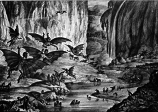
In August 1835, a New York newspaper called The Sun published the first in a series of articles claiming that astronomer Sir John Herschel had discovered life on the Moon using a revolutionary new telescope in South Africa. The life included bison, tail-less beavers, unicorns, and bat-winged humanoids who built temples. The articles were attributed to a fictitious companion of Herschel's. The Sun's circulation tripled. Herschel, in Cape Town doing actual astronomy, was amused and then annoyed when people kept asking him about the bat people. The series ended when the telescope supposedly burned down. The author was never publicly identified in the Sun's lifetime. The hoax is still studied in journalism schools.
August 25, 1835
191 years ago
Key Figures & Places
What Else Happened on August 25
cerca de Pompeya (Italia), segundo día de la letal erupción del volcán Vesubio.
Caesar Julian led 13,000 Roman soldiers against a 35,000-strong Alemanni confederation at Strasbourg and won a crushing victory that killed 6,000 Germanic warri…
Emperor Constantine V publicly humiliated nineteen high-ranking officials upon uncovering a conspiracy, then executed the ringleaders Constantine Podopagouros a…
The Archbishop of Utrecht granted the Dutch settlement of Ommen official city and fortification rights, elevating it from a rural hamlet to a recognized urban c…
In Bologna wird für etwa 6000 Diener die Abschaffung der Leibeigenschaft bekanntgegeben. Die Besitzer werden einmalig aus der Finanzkasse der Stadt entschädigt.…
August 25, 1258. George Mouzalon had served as regent for the young Emperor John IV Laskaris of Nicaea — the Byzantine rump state established after Constantinop…
Talk to History
Have a conversation with historical figures who witnessed this era. Ask questions, explore perspectives, and bring history to life.