

Eight Nations Capture Beijing: Boxer Rebellion Crushed
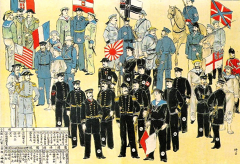
The Eight-Nation Alliance storms Beijing to crush the Boxer Rebellion, driving the Qing court into exile and entrenching foreign dominance over Chinese sovereignty. This occupation extracts massive indemnities that cripple China's economy for decades while exposing the empire's fatal weakness to its own people.
August 14, 1900
126 years ago
Key Figures & Places




What Else Happened on August 14
Huo Guang and fellow officials thrust articles of impeachment against Emperor Liu He before Empress Dowager Shangguan, compelling her to depose the ruler just t…
Octavian held the second of his three consecutive Roman triumphs celebrating the Dalmatian campaigns in 29 BC. The three-day spectacle — Dalmatia, Actium, Egypt…
Macbeth killed King Duncan I of Scotland in battle near Elgin in 1040 — not in his bed, as Shakespeare later imagined. Macbeth ruled Scotland competently for 17…
El Cid, al mando del ejército de la taifa de Zaragoza, vence a la coalición del rey Al-Mundir de Lérida y Sancho Ramírez de Aragón en la batalla de Morella.
Kaiser Heinrich IV. heiratet Adelheid von Kiew, Tochter des Großfürsten Wsewolod I.
Raniero di Bieda wird unter dem Namen Paschalis II. Papst.
Talk to History
Have a conversation with historical figures who witnessed this era. Ask questions, explore perspectives, and bring history to life.