

Watts Erupts: Six Days of Riots Tear Los Angeles
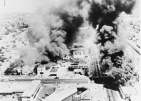
A routine traffic stop on a sweltering August evening in South Los Angeles became the spark for one of the most destructive urban uprisings in American history. California Highway Patrol officer Lee Minikus pulled over 21-year-old Marquette Frye near 116th Street and Avalon Boulevard, and what began as a drunk driving arrest escalated into a physical confrontation as a crowd gathered and Frye's mother intervened. Within hours, the Watts neighborhood erupted. The conditions that fueled the explosion had been building for decades. Black residents of Watts lived in one of the most overcrowded, underserved communities in Los Angeles, trapped by racially restrictive housing covenants and systematic disinvestment. Unemployment ran at roughly 30 percent. The Los Angeles Police Department, under Chief William Parker, had earned a reputation for aggressive tactics in Black neighborhoods that made every police encounter a potential flashpoint. For six days starting August 11, 1965, rioters set fires, looted businesses, and battled police and National Guard troops across a 46-square-mile area. Governor Pat Brown deployed 14,000 National Guard soldiers to restore order. By the time the violence subsided on August 17, 34 people were dead, more than 1,000 were injured, and roughly 3,400 had been arrested. Property damage exceeded $40 million, equivalent to more than $375 million today. The McCone Commission, appointed to investigate the causes, produced a report that critics dismissed as superficial. But the Watts uprising forced a national reckoning with the gap between the legal victories of the civil rights movement and the lived reality of Black Americans in Northern and Western cities. The rebellion made clear that racial injustice was not exclusively a Southern problem.
August 11, 1965
61 years ago
Key Figures & Places
What Else Happened on August 11
The Mesoamerican Long Count calendar begins on a date corresponding to August 11, 3114 BCE in the Gregorian calendar. The Maya didn't choose this date at random…
Hayk the Great struck down the Babylonian tyrant Bel with a single arrow, shattering his army and securing the independence of the Armenian people. This victory…
Greek and Persian fleets fought for three days near the headland of Artemisium while Leonidas held Thermopylae to the south. The Greek navy, outnumbered but fig…
Emperor Trajan formally annexed Dacia as a Roman province, securing the empire's control over the region's vast gold and silver mines. This conquest brought the…
Hadrian assumed control of the Roman Empire following Trajan’s death, inheriting a state stretched to its geographic limits by his predecessor’s conquests. He i…
Claudius Silvanus seized the imperial purple in Cologne after a campaign of slander by his rivals forced his hand against Constantius II. This desperate rebelli…
Talk to History
Have a conversation with historical figures who witnessed this era. Ask questions, explore perspectives, and bring history to life.