Zeppelin Raids Begin: Britain Faces First Aerial Bombs
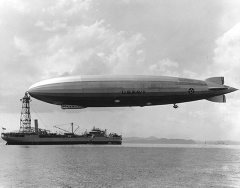
Two German Zeppelins crossed the North Sea on the night of January 19, 1915, and dropped bombs on the English coastal towns of Great Yarmouth and King's Lynn in Norfolk. Four people were killed and sixteen injured. The damage was minor. The significance was not. For the first time in history, civilians in their homes were attacked from the air by a hostile military power, inaugurating a form of warfare that would define the twentieth century. The raid had been authorized personally by Kaiser Wilhelm II, who initially restricted targets to military installations along the English coast. The Zeppelin commanders, navigating in darkness over unfamiliar terrain with limited instrumentation, could not distinguish military from civilian areas and dropped their bombs on whatever lay below. The distinction between authorized and actual targets would prove meaningless throughout the air war that followed. Germany had invested heavily in Zeppelin technology before the war. Count Ferdinand von Zeppelin's rigid airships could travel farther and carry heavier payloads than any airplane of the era. The German Navy saw them as the ideal weapon for striking at Britain, which sat beyond the reach of ground forces and could not be effectively targeted by the short-range aircraft available in 1915. The airships flew at altitudes above 10,000 feet, initially beyond the reach of British fighter planes and anti-aircraft guns. The psychological impact far exceeded the physical damage. Britain had not been attacked on its home territory since the Napoleonic Wars. The idea that enemy aircraft could appear over English cities at night, invisible and unreachable, created a terror that the small number of casualties did not justify in military terms. Blackout orders were imposed across eastern England. Anti-aircraft batteries and searchlight units were deployed. Fighter squadrons were pulled from France to defend the homeland. Over the course of the war, German Zeppelins and later Gotha bombers killed roughly 1,400 British civilians in air raids. The numbers were tiny compared to the carnage on the Western Front, but the precedent was profound. The British responded by forming the Royal Air Force in 1918, the world's first independent air force, created specifically because the Zeppelin raids had demonstrated that air power required unified command. The bombs that fell on Great Yarmouth opened a chapter of warfare that would lead, within three decades, to the firebombing of Dresden, the Blitz, and ultimately Hiroshima.
January 19, 1915
111 years ago
Key Figures & Places

What Else Happened on January 19
Twelve legions. A single moment. When Gratian tapped Theodosius to command Rome's entire eastern frontier, he wasn't just promoting a general—he was handing ove…
Clovis II ascended the throne of Neustria and Burgundy at age five, following the death of his father, Dagobert I. His long minority empowered the palace mayors…
Twelve days into the siege, water ran low. The Kucha defenders watched their wells shrink, their hope evaporating faster than their precious liquid. Ashina She'…
Rouen surrendered to Henry V after a brutal six-month siege, placing the heart of Normandy under English control. This victory dismantled the last major bastion…
The Byzantine throne wasn't big enough for just one Palaiologos. John VIII, barely out of his teens, was thrust into imperial politics through a strategic marri…
A tiny Italian fortress, barely bigger than a village, stood no chance against the thundering French artillery. But Mirandola wasn't just any town—it was the pr…
Talk to History
Have a conversation with historical figures who witnessed this era. Ask questions, explore perspectives, and bring history to life.