
Typographer Patented: Forerunner of the Typewriter
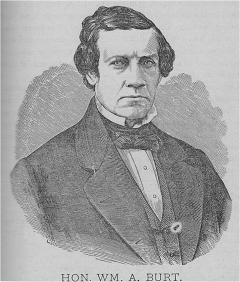
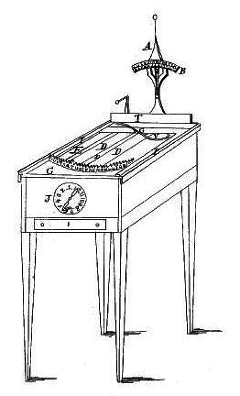
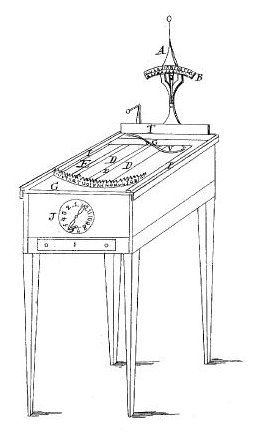
Forty-four keys mounted on a rotating semicircle, operated by a lever that swung each letter into position one at a time, and every word took roughly a minute to spell out. William Austin Burt patented his "typographer" and earned the distinction of inventing the first writing machine registered in the United States, though the device was so slow that it was actually harder to use than a pen. Burt was a surveyor and inventor from Michigan Territory who had already patented a solar compass that would prove far more commercially successful. His typographer consisted of a wooden frame about a foot wide with individual type characters arranged on a rotating mechanism. The operator turned the dial to the desired letter, pressed it against an inked ribbon, and produced a printed character on paper. The process had to be repeated for every single letter, making it grotesquely impractical for anything longer than a few sentences. The patent application itself, reportedly typed on the machine and submitted to the U.S. Patent Office, survives as one of the earliest known documents produced by a mechanical writing device. John D. Quincy, the patent examiner who reviewed the application, was apparently impressed enough to call the machine "the great curiosity" despite its obvious limitations. Burt never manufactured the typographer commercially, and the device influenced no subsequent designs. The practical typewriter would not emerge for another forty years, when Christopher Latham Sholes, Carlos Glidden, and Samuel Soule developed the machine that Remington and Sons began mass-producing in 1873. Sholes introduced the QWERTY keyboard layout, which remains standard more than 150 years later. The gap between Burt's patent and the first usable typewriter illustrates a pattern common in technological history: the original idea often arrives decades before the engineering catches up. Burt saw the future clearly but lacked the materials and mechanisms to reach it.
July 23, 1829
197 years ago
Key Figures & Places

United States
Wikipedia
typewriter
Wikipedia
William Austin Burt
Wikipedia
Typographer
Wikipedia
typographer
Wikipedia
William Austin Burt
Wikipedia
Typographer (typewriter)
Wikipedia
Typewriter
Wikipedia
Patent
Wikipedia
United States
Wikipedia
Commodore International
Wikipedia
Amiga
Wikipedia
Amiga 1000
Wikipedia
Lincoln Center for the Performing Arts
Wikipedia
New York City
Wikipedia
Andy Warhol
Wikipedia
Debbie Harry
Wikipedia
Blondie (groupe)
Wikipedia
What Else Happened on July 23
Byzantine Emperor Nikephoros I sacked the Bulgarian capital of Pliska, seizing Khan Krum's treasury and devastating the city's defenses in a brutal raid. Nikeph…
Knights Hospitaller galleys decimated an Aydinid fleet off the coast of Chios, shattering Turkish naval dominance in the Aegean. This decisive engagement secure…
Three hundred colonists set sail from Dieppe, France, bound for the rugged shores of New France. This expedition reinforced French territorial claims in North A…
Danish-Norwegian forces seized the strategic harbor town of Marstrand from Sweden, severing the Swedish navy’s primary connection to the North Sea. This capture…
Prussian forces reclaimed Mainz from French radical troops, dismantling the short-lived Republic of Mainz. This victory restored the authority of the Elector of…
Sir Thomas Maitland arrived in Malta on July 23, 1813, as its first official British Governor, instantly converting the island from a fragile protectorate into …
Talk to History
Have a conversation with historical figures who witnessed this era. Ask questions, explore perspectives, and bring history to life.