

Battle of the Golden Spurs: Flemish Militia Crushes French Knights
The French knights couldn't believe commoners had won. At Kortrijk on July 11, 1302, Flemish weavers and guild workers slaughtered France's armored nobility in a muddy field—killing roughly 1,000 knights, including Robert II of Artois. The victors collected 500 golden spurs from the fallen nobles and hung them in a church. Infantry had beaten cavalry. Craftsmen had destroyed aristocrats. And for the first time in medieval Europe, a feudal king learned his mounted warriors weren't invincible against determined citizens fighting for their own cities.
July 11, 1302
724 years ago
Key Figures & Places

France
Wikipedia
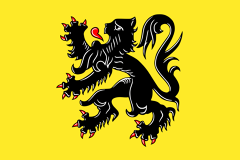
Flanders
Wikipedia

Dutch language
Wikipedia
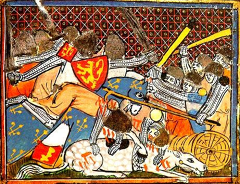
Battle of the Golden Spurs
Wikipedia

Battle of the Golden Spurs
Wikipedia

Flanders
Wikipedia

Cortrique
Wikipedia

Belgium
Wikipedia

Nord (département français)
Wikipedia

Hauts-de-France
Wikipedia

France
Wikipedia

European Union
Wikipedia

Flemish Community Day
Wikipedia

Italy
Wikipedia

Flandres
Wikipedia

Kabylie
Wikipedia

Algeria
Wikipedia

فاطمة نسومر
Wikipedia
Physics
Wikipedia

Amedeo Avogadro
Wikipedia

Mol
Wikipedia

Gaz
Wikipedia
Flemish people
Wikipedia
What Else Happened on July 11
Kaiser Caracalla verleiht mit der Verkündung der Constitutio Antoniniana allen freien Bewohnern des Römischen Imperiums das Bürgerrecht.
Western Roman Emperor Anthemius met his end at the hands of his own generals after they cornered him inside St. Peter’s Basilica. His execution shattered the la…
le nouveau roi des Francs Pépin le Bref premier carolingien du titre réaffirme un monopole royal de frappe de la monnaie dans un capitulaire de Ver et en émetta…
Byzantine Emperor Michael I steps down on July 11, 813, handing power to General Leo the Armenian before entering monastic life as Athanasius. This transfer end…
Charles the Simple granted the lower Seine valley to the Viking leader Rollo, ending decades of Norse raids in exchange for a defensive buffer against future in…
Conrad III devient roi de Bourgogne transjurane.[réf. nécessaire]
Talk to History
Have a conversation with historical figures who witnessed this era. Ask questions, explore perspectives, and bring history to life.