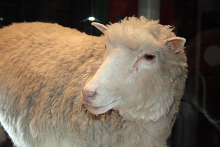
Dolly the Sheep Born: First Mammal Cloned from Adult
Scientists at Scotland s Roslin Institute took a single mammary gland cell from a six-year-old Finn Dorset sheep and used it to create a genetically identical lamb. Dolly, born on July 5, 1996, was the first mammal ever cloned from an adult somatic cell, proving that specialized cells could be reprogrammed to create an entirely new organism. The achievement overturned a fundamental assumption of developmental biology and ignited a global debate about the ethics of cloning that has never fully subsided. Ian Wilmut and Keith Campbell led the team that developed the technique, called somatic cell nuclear transfer. They removed the nucleus from an egg cell of a Scottish Blackface sheep and replaced it with the nucleus from the mammary cell of the Finn Dorset donor. An electrical pulse fused the two and triggered cell division. The resulting embryo was implanted in a surrogate mother. Out of 277 attempts, Dolly was the only lamb born alive. The announcement, published in Nature in February 1997, landed on front pages worldwide. The immediate public reaction focused on the possibility of human cloning, prompting President Clinton to request a report from the National Bioethics Advisory Commission within 90 days. Legislation banning human reproductive cloning was introduced in multiple countries. The Vatican condemned the research. Scientists rushed to replicate the result in other species. Dolly lived at the Roslin Institute for six years, producing six lambs through normal reproduction. She developed arthritis at an unusually young age and was diagnosed with a progressive lung disease common in older sheep. Researchers debated whether her health problems were related to the cloning process or simply bad luck. She was euthanized on February 14, 2003, at age six — roughly half the normal lifespan of a Finn Dorset sheep. The technique that created Dolly opened the door to therapeutic cloning, where patient-specific stem cells could theoretically be produced for medical treatment without immune rejection. Dolly s taxidermied body is displayed at the National Museum of Scotland in Edinburgh.
July 5, 1996
30 years ago
Key Figures & Places
What Else Happened on July 5
Theophilus Patricius engineered a bridge across the Danube's 1,400-meter width using twenty stone piers sunk into one of Europe's fastest currents. The architec…
King John Balliol and Philip IV of France formalized the Auld Alliance, committing both nations to military support against Edward I of England. This mutual def…
Louis of Burgundy and Ferdinand of Majorca clashed at the Battle of Manolada, fighting for control of the Principality of Achaea. Ferdinand died in the skirmish…
Pope Gregory XIII gave the Maronites their own college in Rome, but he died before signing the papers. His successor, Sixtus V, finished the job in 1584. The sc…
Pedro Lopes de Sousa marched 20,000 Portuguese and Lascarin troops into Kandy's interior in October 1594, convinced the mountain kingdom would fall within days.…
John Guy departed Bristol with 39 colonists to establish the first permanent English settlement in Newfoundland at Cupids. This expedition transitioned England’…
Talk to History
Have a conversation with historical figures who witnessed this era. Ask questions, explore perspectives, and bring history to life.