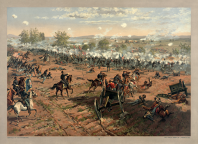
Gettysburg Turns Tide: Union Halts Lee's Invasion
Confederate General Robert E. Lee marched 75,000 troops into Pennsylvania in the summer of 1863, gambling that a decisive victory on Union soil would break Northern morale and force a negotiated peace. Instead, his Army of Northern Virginia collided with the Army of the Potomac at a crossroads town neither side had chosen, and three days of carnage produced the bloodiest battle in American history. The collision began almost by accident on July 1 when Confederate infantry searching for supplies encountered Union cavalry under Brigadier General John Buford west of Gettysburg. Buford s dismounted troopers held the ridges long enough for Union reinforcements to arrive, but Confederate numbers pushed the defenders back through the town and onto Cemetery Hill by nightfall. The high ground would prove decisive. On July 2, Lee ordered attacks against both Union flanks. Fighting raged across terrain that would become legendary — Little Round Top, the Peach Orchard, the Wheatfield, Devil s Den. Colonel Joshua Chamberlain s 20th Maine held the extreme left of the Union line on Little Round Top with a bayonet charge when ammunition ran out. The Union line bent but never broke. Lee s final gamble came on July 3. Approximately 12,500 Confederate soldiers advanced three-quarters of a mile across open ground toward the center of the Union line on Cemetery Ridge in what became known as Pickett s Charge. Union artillery and rifle fire shredded the formation. Barely half returned. The three days produced roughly 51,000 casualties on both sides. Lee retreated to Virginia on July 4, never to mount another major offensive in the North. Combined with the fall of Vicksburg the same day, Gettysburg marked the moment the Confederacy s strategic position became untenable.
July 1, 1863
163 years ago
Key Figures & Places
What Else Happened on July 1
The prefect of Egypt controlled Rome's grain supply—and he knew it. Tiberius Julius Alexander, a Jewish apostate commanding two legions in Alexandria, declared …
Narses brought 20,000 men to face Totila's Ostrogoths at Busta Gallorum, near modern Gualdo Tadino. The Byzantine eunuch general was 74 years old. Totila, half …
Prince Bohemond of Taranto's Crusader forces routed Sultan Kilij Arslan I's Seljuk army at Dorylaeum, breaking open the road to the Holy Land during the First C…
The Castilian army marched 60,000 strong into Granada's Sierra Elvira on July 1st, 1431—the largest Christian force assembled in decades. King Juan II's troops …
Hernán Cortés lost 860 Spanish soldiers in a single night trying to sneak out of Tenochtitlan with stolen Aztec gold. June 30, 1520. The causeway bridges were g…
Hernán Cortés and his forces fled Tenochtitlan under the cover of darkness during the Noche Triste, suffering heavy casualties as Aztec warriors attacked them o…
Talk to History
Have a conversation with historical figures who witnessed this era. Ask questions, explore perspectives, and bring history to life.