Versailles Signed: WWI Ends, Seeds of War Sown
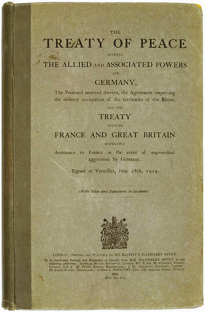
Delegates from 32 nations gathered in the Hall of Mirrors at Versailles to sign the treaty that ended the Great War and planted the seeds of an even greater one. On June 28, 1919, exactly five years after the assassination of Archduke Franz Ferdinand, Germany signed the Treaty of Versailles, accepting responsibility for the war and agreeing to punishing terms that would destabilize European politics for the next two decades. The treaty was the product of six months of negotiations in Paris, dominated by the "Big Four": Woodrow Wilson of the United States, Georges Clemenceau of France, David Lloyd George of Britain, and Vittorio Orlando of Italy. Their goals were fundamentally incompatible. Wilson wanted a just peace built around his Fourteen Points and a new League of Nations. Clemenceau, whose country had suffered 1.4 million dead and enormous physical destruction, demanded security guarantees and punitive reparations. Lloyd George navigated between them, seeking to weaken Germany without destroying it. The terms imposed on Germany were severe. Article 231, the "war guilt clause," forced Germany to accept sole responsibility for the conflict. The treaty stripped Germany of 13 percent of its territory and 10 percent of its population, eliminated its air force, reduced its army to 100,000 men, and imposed reparations eventually set at 132 billion gold marks, equivalent to roughly $400 billion today. Germany’s delegation was given no opportunity to negotiate and signed under threat of resumed hostilities. The treaty’s harshest critics proved prophetic. John Maynard Keynes resigned from the British delegation and published "The Economic Consequences of the Peace," predicting the reparations would cripple Germany’s economy and breed resentment. Marshal Ferdinand Foch of France took the opposite view, calling the treaty too lenient and predicting it would last only twenty years. The armistice he predicted expired almost exactly on schedule: Germany invaded Poland on September 1, 1939, twenty years and sixty-four days after Versailles was signed.
June 28, 1919
107 years ago
Key Figures & Places
What Else Happened on June 28
Crusader forces broke the siege of Antioch by routing Kerbogha’s army in a decisive field battle. This victory shattered the coalition of local Muslim rulers an…
Muhammed VI seized the Nasrid throne in Granada by orchestrating the assassination of his brother-in-law, Ismail II. This violent coup fractured the ruling dyna…
Both leaders died on the same battlefield, and the myths born from their blood shaped Balkan politics for six centuries. At the Battle of Kosovo on June 28, 138…
Edward wasn't supposed to be king. He was 18 years old, six-foot-four, and had just watched his father's severed head get mounted on the gates of York with a pa…
Edward wasn't supposed to be king. His father died at Wakefield without ever wearing the crown, and Henry VI still sat on the throne when nineteen-year-old Edwa…
France's outnumbered army crushed the Neapolitans and Spanish at Seminara in 1495, and the humiliation hit Gonzalo de Córdoba hard. He'd commanded that losing s…
Talk to History
Have a conversation with historical figures who witnessed this era. Ask questions, explore perspectives, and bring history to life.