

George II Leads at Dettingen: Last Monarch in Battle
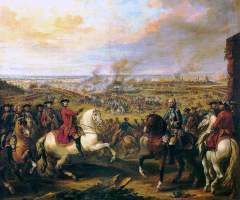
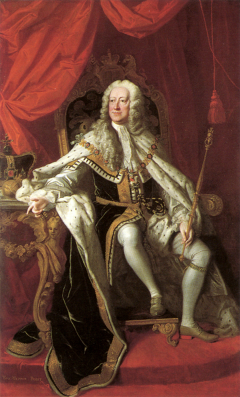
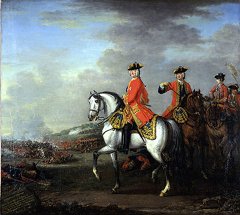
King George II of Great Britain drew his sword and led his troops forward on horseback at the Battle of Dettingen on June 27, 1743, becoming the last British monarch to personally command an army in battle. The 59-year-old king’s horse bolted at the sound of cannon fire early in the engagement, nearly carrying him into French lines, before George dismounted and led his infantry on foot through a day of fierce fighting along the Main River in Bavaria. The battle arose from the War of the Austrian Succession, a continent-wide conflict triggered by Prussia’s seizure of Silesia from Austria in 1740. George II, who was also the Elector of Hanover, had personal territorial interests in the conflict and accompanied his army to the Continent despite the objections of his ministers. The combined British, Hanoverian, and Austrian force of roughly 37,000 men found itself trapped in a narrow defile near the village of Dettingen, hemmed in by the Main River and wooded hills, with a French army of 30,000 blocking their line of retreat. The French commander, the Duc de Gramont, abandoned his strong defensive position to attack, a decision that his superior, Marshal Noailles, had explicitly forbidden. The premature French advance allowed the Allied infantry to form battle lines and deliver devastating volleys. The fighting was particularly brutal along the riverbank, where French cavalry charges were repulsed with heavy losses. George’s personal presence steadied his troops during the most dangerous moments, though critics noted his horse had been running away when he dismounted. The Allied victory was tactically significant but strategically indecisive. France lost roughly 5,000 casualties to the Allies’ 3,000, and Gramont’s army retreated across the river. Handel composed his famous "Dettingen Te Deum" to celebrate the victory. George II’s battlefield command marked the end of an era in which European monarchs personally risked their lives in combat, a tradition stretching back millennia that ended on a muddy Bavarian riverbank.
June 27, 1743
283 years ago
Key Figures & Places
What Else Happened on June 27
A city-state the size of a small county held off the Ottoman Empire, the Venetian Republic, and every other regional bully for centuries — through diplomacy, no…
Blacksmith Michael An Gof and lawyer Thomas Flamank met their ends at Tyburn after leading thousands of Cornishmen on a march to London to protest crushing war …
Amerigo Vespucci wasn't supposed to be famous. Columbus got there first, got the credit, got the statues. But Vespucci wrote better letters. His vivid accounts …
Thirteen Protestants perished at the stake in Stratford-le-Bow, condemned for refusing to renounce their faith during the Marian persecutions. This public execu…
Peter the Great shattered the Swedish Empire’s dominance at the Battle of Poltava, forcing Charles XII into exile in the Ottoman Empire. This decisive Russian v…
King George II personally led his troops into the fray at the Battle of Dettingen, securing a victory against the French. This engagement remains the final inst…
Talk to History
Have a conversation with historical figures who witnessed this era. Ask questions, explore perspectives, and bring history to life.