

Solferino's Carnage: Battle That Inspired the Red Cross
The carnage at Solferino was so overwhelming that a Swiss businessman watching from a nearby hillside decided to change the rules of war. On June 24, 1859, a combined Franco-Sardinian army under Napoleon III and Victor Emmanuel II clashed with Austrian forces under Emperor Franz Joseph I in northern Italy, producing more than 40,000 casualties in a single day of fighting. The battle was the last major engagement in world history where all armies were personally commanded by their monarchs on the field. The battle was part of the Second Italian War of Independence, in which France allied with the Kingdom of Sardinia to drive Austria out of northern Italy. The two armies stumbled into each other near the town of Solferino, south of Lake Garda, without either side having planned a major engagement. The fighting devolved into a series of chaotic close-quarters struggles across villages, farmhouses, and hilltops, with bayonets and cavalry sabers doing much of the killing. The heat was extreme, and water was scarce. Henry Dunant, a Geneva businessman who had traveled to Italy hoping to meet Napoleon III on a private business matter, arrived at Solferino as the battle ended. He found roughly 9,000 wounded soldiers from both sides abandoned on the battlefield with almost no medical care. Dunant organized local civilians and tourists to help, improvising field hospitals in churches and houses. He insisted on treating wounded soldiers regardless of nationality, a radical concept at the time. Dunant published "A Memory of Solferino" in 1862, describing what he had witnessed and proposing the creation of permanent volunteer relief organizations to care for war wounded. His book led directly to the founding of the International Committee of the Red Cross in 1863 and the first Geneva Convention in 1864, which established the legal framework for the humane treatment of wartime casualties that remains in force today.
June 24, 1859
167 years ago
Key Figures & Places
Italy
Wikipedia
Austria
Wikipedia
Sardinia
Wikipedia
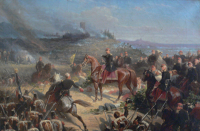
Battle of Solferino
Wikipedia
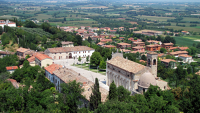
Solferino
Wikipedia

Battle of Solferino
Wikipedia

Sardinia
Wikipedia

Solferino
Wikipedia

France
Wikipedia

Kingdom of Sardinia
Wikipedia

Austrian Empire
Wikipedia

Henry Dunant
Wikipedia

International Red Cross and Red Crescent Movement
Wikipedia

Castiglione delle Stiviere
Wikipedia

Étienne Mougeotte
Wikipedia

LCI
Wikipedia

Canal de televisión
Wikipedia

Información
Wikipedia

Cardinal Richelieu
Wikipedia

Louis XIII
Wikipedia

Armenia
Wikipedia
Richard Melillo
Wikipedia

judo
Wikipedia

European Union
Wikipedia

Eurozone
Wikipedia

Marche des fiertés
Wikipedia
30 juin
Wikipedia
What Else Happened on June 24
Mursili II marched his Hittite army into the highlands to crush the Kingdom of Azzi-Hayasa, ending years of border skirmishes that threatened his northern front…
Lake Bracciano had fed Rome's right bank for centuries through crude channels. Trajan fixed that in 109 AD with 40 kilometers of engineered stone, delivering cl…
Glycerius had been emperor for less than a year when Julius Nepos sailed from Dalmatia with enough soldiers to make the point without a battle. No siege. No blo…
The largest battle in Irish history was decided by a king who may have lost his mind before it even started. Domnall II, High King of Ireland, faced a coalition…
Three longships appeared in the Loire River on a Sunday — the feast day of St. John the Baptist, June 24, 843. Terrible timing for Nantes. The cathedral was pac…
Poland didn't have an army — it had a duke with something to prove. Mieszko I lured the Saxon forces of Hodo deep into a forest trap near Cedynia in 972, lettin…
Talk to History
Have a conversation with historical figures who witnessed this era. Ask questions, explore perspectives, and bring history to life.