

Bolivar Wins Carabobo: Venezuela Breaks Free From Spain
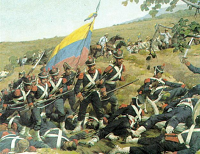
Simón Bolívar destroyed Spanish power in Venezuela in less than an hour. At the Battle of Carabobo on June 24, 1821, a patriot army of roughly 6,500 troops routed a royalist force of similar size defending the approaches to Valencia, the last major Spanish stronghold in the country. The battle lasted barely fifty minutes, with the decisive blow struck by a flanking movement through rough terrain that the Spanish commander had considered impassable. Bolívar had been fighting for South American independence for more than a decade, suffering devastating defeats and narrow escapes before assembling the coalition that would finally break Spanish control. The Carabobo campaign followed his greatest strategic achievement: the 1819 crossing of the Andes with 2,500 men to liberate New Granada, modern-day Colombia. With Colombia secured, Bolívar turned south toward Venezuela, where Spanish Field Marshal Miguel de la Torre held a strong defensive position on the plain of Carabobo. The key to the battle was the British Legion, a unit of approximately 1,100 foreign volunteers, many of them veterans of the Napoleonic Wars, who executed the critical flanking march through a ravine on the royalist right. The Legion took severe casualties but broke the Spanish line, and Bolívar’s cavalry completed the rout. La Torre retreated to Puerto Cabello with the remnants of his army, and Bolívar entered Caracas five days later to widespread celebration. Carabobo effectively ended three centuries of Spanish rule in Venezuela, though scattered royalist resistance continued until the fall of Puerto Cabello in 1823. Bolívar used the victory as a springboard for his campaign to liberate Ecuador and Peru, creating the short-lived Gran Colombia that united Venezuela, Colombia, and Ecuador under a single government. The battle remains Venezuela’s most celebrated military victory and is commemorated as Army Day.
June 24, 1821
205 years ago
Key Figures & Places
What Else Happened on June 24
Mursili II marched his Hittite army into the highlands to crush the Kingdom of Azzi-Hayasa, ending years of border skirmishes that threatened his northern front…
Lake Bracciano had fed Rome's right bank for centuries through crude channels. Trajan fixed that in 109 AD with 40 kilometers of engineered stone, delivering cl…
Glycerius had been emperor for less than a year when Julius Nepos sailed from Dalmatia with enough soldiers to make the point without a battle. No siege. No blo…
The largest battle in Irish history was decided by a king who may have lost his mind before it even started. Domnall II, High King of Ireland, faced a coalition…
Three longships appeared in the Loire River on a Sunday — the feast day of St. John the Baptist, June 24, 843. Terrible timing for Nantes. The cathedral was pac…
Poland didn't have an army — it had a duke with something to prove. Mieszko I lured the Saxon forces of Hodo deep into a forest trap near Cedynia in 972, lettin…
Talk to History
Have a conversation with historical figures who witnessed this era. Ask questions, explore perspectives, and bring history to life.