St. John's Dance: Medieval Aachen's Mass Hysteria
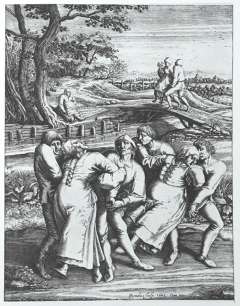
Hundreds of people in the streets of Aachen could not stop dancing. On June 24, 1374, a mysterious outbreak of compulsive movement struck the German city during the feast of St. John the Baptist, with afflicted residents dancing wildly for hours or days until they collapsed from exhaustion, injury, or heart failure. The episode spread to nearby cities in the Low Countries, including Liège, Utrecht, and Tongeren, affecting thousands over the following months. Medieval chroniclers described the victims as appearing possessed, screaming and begging for help while their bodies continued to move. Some dancers reported terrifying visions of demons or floods of blood. Others stripped off their clothing or demanded that onlookers stamp on their feet to stop the compulsion. Local authorities, unsure whether the affliction was medical or spiritual, organized religious processions and exorcisms. Some towns hired musicians to play along, hoping the dancers would exhaust themselves more quickly. Modern explanations for the dancing plague remain contested. The ergotism theory, which attributes the behavior to hallucinations caused by ergot fungus contaminating grain supplies, has fallen out of favor because ergot restricts blood flow to the extremities, making sustained dancing physically impossible. The leading contemporary hypothesis, advanced by historian John Waller, points to mass psychogenic illness triggered by extreme stress: the Rhineland in 1374 was recovering from the Black Death, widespread flooding, and famine, conditions that produced apocalyptic anxiety across the population. The 1374 outbreak was neither the first nor the last episode of mass dancing mania in Europe. Similar events were recorded from the seventh century through the famous 1518 Strasbourg dancing plague, when hundreds danced in the streets for weeks. These outbreaks disappeared after the seventeenth century, leaving behind one of medieval history’s most unsettling and least understood phenomena.
June 24, 1374
652 years ago
Key Figures & Places

What Else Happened on June 24
Mursili II marched his Hittite army into the highlands to crush the Kingdom of Azzi-Hayasa, ending years of border skirmishes that threatened his northern front…
Lake Bracciano had fed Rome's right bank for centuries through crude channels. Trajan fixed that in 109 AD with 40 kilometers of engineered stone, delivering cl…
Glycerius had been emperor for less than a year when Julius Nepos sailed from Dalmatia with enough soldiers to make the point without a battle. No siege. No blo…
The largest battle in Irish history was decided by a king who may have lost his mind before it even started. Domnall II, High King of Ireland, faced a coalition…
Three longships appeared in the Loire River on a Sunday — the feast day of St. John the Baptist, June 24, 843. Terrible timing for Nantes. The cathedral was pac…
Poland didn't have an army — it had a duke with something to prove. Mieszko I lured the Saxon forces of Hodo deep into a forest trap near Cedynia in 972, lettin…
Talk to History
Have a conversation with historical figures who witnessed this era. Ask questions, explore perspectives, and bring history to life.