England Crushes French Fleet: Sluys Secures Channel Dominance
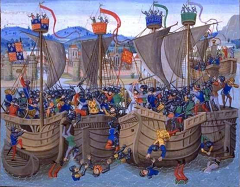
Edward III of England climbed to the top of his flagship’s castle and personally directed the destruction of the French fleet. At the Battle of Sluys on June 24, 1340, an English force of roughly 150 ships attacked a larger French fleet anchored in the harbor of Sluys in modern-day Belgium, sinking or capturing nearly every enemy vessel in a day-long engagement that killed an estimated 16,000 to 20,000 French sailors and soldiers. The battle was the opening clash of what would become the Hundred Years’ War. Edward had claimed the French throne in 1337, and Philip VI of France had responded by assembling a massive fleet to invade England. The French fleet, numbering roughly 200 ships, was chained together in defensive lines across the harbor mouth, a tactic that prevented escape but also limited maneuverability. French commanders had ignored the advice of their Genoese mercenary admiral, who urged them to meet the English in open water. Edward exploited the French formation ruthlessly. English longbowmen poured arrows into the packed decks from a distance, then grappling hooks pulled the ships together for brutal hand-to-hand combat. The battle began in the morning with the sun and wind favoring the English and continued until nightfall. Edward himself was wounded in the fighting. The French losses were so catastrophic that, according to contemporary accounts, no one at court dared tell Philip VI the news until his jester said the English were cowards because they had not jumped into the sea like the French. Sluys gave England control of the English Channel for the next decade and eliminated any serious threat of a French invasion. Edward was free to pursue the war on French soil, a strategic advantage that would lead to English victories at Crécy in 1346 and Poitiers in 1356. Command of the sea proved as decisive in medieval warfare as it would in every European conflict that followed.
June 24, 1340
686 years ago
Key Figures & Places

What Else Happened on June 24
Mursili II marched his Hittite army into the highlands to crush the Kingdom of Azzi-Hayasa, ending years of border skirmishes that threatened his northern front…
Lake Bracciano had fed Rome's right bank for centuries through crude channels. Trajan fixed that in 109 AD with 40 kilometers of engineered stone, delivering cl…
Glycerius had been emperor for less than a year when Julius Nepos sailed from Dalmatia with enough soldiers to make the point without a battle. No siege. No blo…
The largest battle in Irish history was decided by a king who may have lost his mind before it even started. Domnall II, High King of Ireland, faced a coalition…
Three longships appeared in the Loire River on a Sunday — the feast day of St. John the Baptist, June 24, 843. Terrible timing for Nantes. The cathedral was pac…
Poland didn't have an army — it had a duke with something to prove. Mieszko I lured the Saxon forces of Hodo deep into a forest trap near Cedynia in 972, lettin…
Talk to History
Have a conversation with historical figures who witnessed this era. Ask questions, explore perspectives, and bring history to life.