

Oregon Treaty Settles Border at 49th Parallel
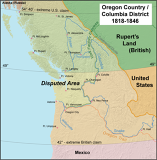
The Oregon Treaty, signed on June 15, 1846, established the 49th parallel as the boundary between the United States and British North America from the Rocky Mountains to the Strait of Juan de Fuca, resolving a territorial dispute that had threatened to produce a third Anglo-American war. The agreement divided the vast Oregon Country, jointly occupied by both nations since 1818, giving the United States what would become the states of Oregon, Washington, Idaho, and parts of Montana and Wyoming. The dispute had been escalating for years. President James K. Polk had campaigned in 1844 on the belligerent slogan "Fifty-four Forty or Fight," demanding American sovereignty over the entire Oregon Country up to the southern boundary of Russian Alaska at 54 degrees, 40 minutes north latitude. Expansionist Democrats wanted the entire Pacific Northwest. Britain, which had a strong commercial presence through the Hudson's Bay Company and thousands of British subjects in the region, refused to concede territory north of the Columbia River. Polk's aggressive rhetoric masked a willingness to compromise. He was already fighting a war with Mexico that had begun in April 1846 and could not risk a simultaneous conflict with Britain. British Foreign Secretary Lord Aberdeen, similarly eager to avoid war over remote wilderness, proposed the 49th parallel, which had been the boundary east of the Rockies since 1818. The compromise preserved all of Vancouver Island for Britain, even though its southern tip extends below the 49th parallel. The treaty's most lasting consequence was establishing the longest undefended border in the world. The 49th parallel, an arbitrary line on a map with no relationship to geography, culture, or watershed boundaries, became one of the most stable international boundaries in modern history.
June 15, 1846
180 years ago
Key Figures & Places

What Else Happened on June 15
Assyrian astronomers recorded a total solar eclipse on June 15, 763 BC, noting the event in the limmu lists of King Ashur-dan III. This precise observation prov…
Pope Sergius II anointed Louis II as King of Italy in Rome, formalizing the Carolingian grip on the Italian peninsula. This coronation solidified the alliance b…
Robert I won the battle and still lost everything. He defeated Charles the Simple's forces at Soissons in 923, then took an arrow or sword blow — accounts disag…
The fleet that decided Norway's future wasn't won by numbers — Sverre's Birkebeiner force was massively outnumbered. But Sverre had a trick: he rammed Magnus's …
King Magnus V fell in the freezing waters of Sognefjord during the Battle of Fimreite, ending his long struggle for the Norwegian throne. His defeat cleared the…
King John affixed his seal to the Magna Carta at Runnymede, bowing to pressure from rebellious barons to curb his absolute power. This charter established the p…
Talk to History
Have a conversation with historical figures who witnessed this era. Ask questions, explore perspectives, and bring history to life.