Paris Occupied: France's Capital Surrenders to Germany
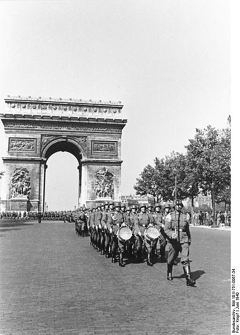
German forces entered Paris unopposed on June 14, 1940, after the French government declared it an "open city" to spare it from aerial bombardment and artillery fire. Wehrmacht troops marched through empty boulevards as roughly two million Parisians had already fled south in what became known as l'exode, the largest mass displacement in French history. A massive swastika banner was hung from the Arc de Triomphe within hours. The fall of Paris came just five weeks after Germany launched its Western offensive on May 10. The Wehrmacht's blitzkrieg through the Ardennes forest, considered impassable by French military planners, had outflanked the Maginot Line and split Allied forces in two. British and French troops were evacuated from Dunkirk between May 26 and June 4, and German forces then turned south. French resistance collapsed with shocking speed. The army that had fought Germany to a bloody standstill for four years in World War I lasted barely six weeks in the second. General Fedor von Bock led the German troops into the capital. French military governor General Henri Dentz, left behind to ensure an orderly handover, surrendered the city formally. The next day, June 15, German officers breakfasted at the Ritz and went shopping on the Champs-Elysees. Marshal Philippe Petain, who had replaced Paul Reynaud as head of government on June 16, requested armistice terms on June 17. The armistice, signed on June 22 in the same railway car where Germany had surrendered in 1918, divided France into an occupied northern zone under German military control and a nominally autonomous southern zone governed by Petain's Vichy regime. Paris remained under occupation for over four years, until its liberation by Free French and American forces on August 25, 1944.
June 14, 1940
86 years ago
Key Figures & Places

What Else Happened on June 14
Henry the Lion established Munich by destroying a rival bridge to force merchant traffic through his own toll-paying settlement on the Isar. This calculated mov…
Half of England belonged to a French prince, and almost nobody stopped him. Louis of France crossed the Channel in 1216 at the invitation of English barons furi…
The Song Dynasty crowned a seven-year-old emperor in a city they were already fleeing. Zhao Shi became Emperor Duanzong not in a palace but in exile, Fuzhou ser…
Kublai Khan's navy never saw it coming. Prince Trần Quang Khải didn't wait for the Mongols to land — he hit them on the water at Chương Dương, where the fleet w…
Nayan thought the old blood still meant something. As a direct descendant of Genghis Khan's brothers, he commanded 60,000 warriors and believed Mongol tradition…
A fourteen-year-old boy rode out to meet an army. Richard II, barely a king, faced thousands of furious peasants at Blackheath while his advisors hid behind Tow…
Talk to History
Have a conversation with historical figures who witnessed this era. Ask questions, explore perspectives, and bring history to life.