Continental Army Formed: Washington Leads Colonial Forces
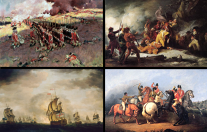
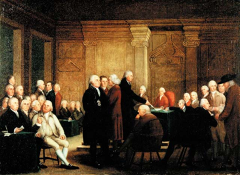
The Continental Congress resolved on June 14, 1775, to organize and fund a unified military force from the ragged collection of New England militia companies besieging British-held Boston. The decision created what would become the Continental Army, and it was driven as much by political necessity as military logic. Massachusetts militiamen had been fighting since Lexington and Concord in April, but Congress needed the other colonies invested in the conflict if the revolution was to succeed. Delegates from the southern and middle colonies were wary of funding what appeared to be a New England war. John Adams of Massachusetts strategically championed the appointment of George Washington, a Virginian, as commander-in-chief the following day. The choice was partly military, Washington being one of the few delegates with significant command experience from the French and Indian War, and partly political, binding Virginia and the southern colonies to the cause. Washington accepted the commission but refused a salary, asking only that Congress cover his expenses. The army Washington inherited was barely an army at all. Roughly 17,000 men were camped around Boston, organized into independent militia units with separate officers, varying terms of enlistment, and almost no standardized equipment, training, or discipline. Many soldiers had enlisted for only a few months and planned to return home for harvest. Desertion rates were staggering. Washington spent his first months imposing basic order on what he privately described as "a mixed multitude of people under very little discipline." June 14 is now celebrated as the birthday of the United States Army. The force that began as an improvised siege camp outside Boston would, six years later, defeat the most powerful military on earth at Yorktown.
June 14, 1775
251 years ago
Key Figures & Places
What Else Happened on June 14
Henry the Lion established Munich by destroying a rival bridge to force merchant traffic through his own toll-paying settlement on the Isar. This calculated mov…
Half of England belonged to a French prince, and almost nobody stopped him. Louis of France crossed the Channel in 1216 at the invitation of English barons furi…
The Song Dynasty crowned a seven-year-old emperor in a city they were already fleeing. Zhao Shi became Emperor Duanzong not in a palace but in exile, Fuzhou ser…
Kublai Khan's navy never saw it coming. Prince Trần Quang Khải didn't wait for the Mongols to land — he hit them on the water at Chương Dương, where the fleet w…
Nayan thought the old blood still meant something. As a direct descendant of Genghis Khan's brothers, he commanded 60,000 warriors and believed Mongol tradition…
A fourteen-year-old boy rode out to meet an army. Richard II, barely a king, faced thousands of furious peasants at Blackheath while his advisors hid behind Tow…
Talk to History
Have a conversation with historical figures who witnessed this era. Ask questions, explore perspectives, and bring history to life.