

Miranda Rights Established: Supreme Court Protects Suspects
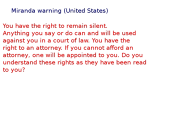
"You have the right to remain silent." Those words, now among the most recognized in American law, did not exist before June 13, 1966, when the Supreme Court ruled 5-4 in Miranda v. Arizona that criminal suspects must be informed of their constitutional rights before police interrogation. The decision transformed law enforcement procedure across the country and made Ernesto Miranda, a laborer with a ninth-grade education and a criminal record, an unlikely figure in constitutional history. Miranda had been arrested in March 1963 for the kidnapping and rape of an eighteen-year-old woman in Phoenix. After two hours of interrogation without being told he had the right to a lawyer or the right to remain silent, Miranda signed a written confession. His court-appointed attorney, Alvin Moore, argued that the confession was coerced, but the trial judge admitted it. Miranda was convicted and sentenced to twenty to thirty years. Chief Justice Earl Warren, writing for the majority, held that the Fifth Amendment protection against self-incrimination required police to clearly inform suspects of their rights before custodial interrogation. The dissent, led by Justice John Marshall Harlan II, warned that the ruling would handcuff law enforcement and allow guilty defendants to escape justice. Harlan called it "a hazardous experimentation" with the criminal justice system. Miranda himself was retried without the confession and convicted again based on other evidence. He was paroled in 1972. On January 31, 1976, Miranda was stabbed to death during a bar fight in Phoenix. Police arrested a suspect, read him his Miranda rights, and the man chose to remain silent. He was released and never charged. The warning Miranda's case created outlived him by decades and has been administered billions of times worldwide.
June 13, 1966
60 years ago
Key Figures & Places
What Else Happened on June 13
Two emperors who hated each other agreed on exactly one thing. Constantine and Licinius met in Milan in February 313, sealed a political marriage, and hammered …
He left home at 21 thinking he'd be back in a year. Ibn Battuta never returned. What started as a hajj to Mecca stretched into 75,000 miles across 44 modern cou…
The oldest military alliance still active today wasn't forged by grand diplomacy — it started as a transaction. England needed wool trade routes. Portugal neede…
Angry mobs led by Wat Tyler stormed and incinerated the Savoy Palace, the opulent London residence of John of Gaunt. By destroying the symbol of royal corruptio…
Henry VIII built the biggest warship on Earth and named it after God. Henry Grace à Dieu — "Henry, Grace of God" — wasn't subtle. At 1,500 tons and carrying 186…

Martin Luther married Katharina von Bora on June 13, 1525, in a ceremony at the Black Cloister in Wittenberg, directly defying the Roman Catholic Church's celib…
Talk to History
Have a conversation with historical figures who witnessed this era. Ask questions, explore perspectives, and bring history to life.