

Le Paradis Massacre: SS Execute 97 British POWs
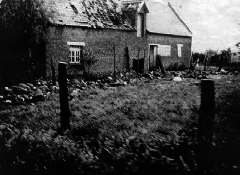
SS troops lined up 97 British prisoners of war against a barn wall and opened fire with machine guns. The Le Paradis massacre of May 27, 1940, was one of the worst atrocities committed against Allied POWs during the Fall of France, and its perpetrator walked free for eight years before justice caught up with him. The 2nd Battalion, Royal Norfolk Regiment, had been defending a farmhouse and surrounding positions near the village of Le Paradis in northern France as part of the rearguard action protecting the Dunkirk evacuation. Outgunned and surrounded by the SS Totenkopf Division, the Norfolks fought until their ammunition was exhausted, then surrendered. SS Hauptsturmfuhrer Fritz Knochlein ordered the prisoners marched to a barn on the Duriez farm. The men were lined up along the barn wall, and two machine guns opened fire. Knochlein's men then walked among the bodies with bayonets and pistols, finishing off the wounded. The entire process took minutes. Two soldiers survived. Privates Albert Pooley and William O'Callaghan, both badly wounded, crawled into a pig sty and were later found by the farm's French owner, Madame Duriez, who hid and fed them until they were captured by a regular Wehrmacht unit that treated them as conventional prisoners of war. Pooley and O'Callaghan spent the rest of the war in POW camps. After liberation, Pooley reported the massacre, but his account was initially dismissed as fabrication. O'Callaghan's corroborating testimony and the eventual discovery of the mass grave at Le Paradis confirmed the atrocity. Knochlein was arrested, tried by a British military tribunal in Hamburg in 1948, convicted of war crimes, and hanged on January 28, 1949. The Le Paradis massacre exposed the SS Totenkopf Division's disregard for the laws of war, a pattern that would repeat across the Eastern Front and at other locations in Western Europe throughout the conflict.
May 27, 1940
86 years ago
Key Figures & Places


What Else Happened on May 27
Simeon ruled Bulgaria for thirty-four years and died in bed—a rarity for medieval emperors who usually met swords or poison. He'd forced Byzantium to pay him tr…
Tsar Simeon the Great died of heart failure, leaving behind a Bulgarian Empire that stretched from the Adriatic to the Black Sea. His death triggered a rapid de…
The Bulgarian army didn't just lose—they evaporated. King Tomislav's Croatian forces caught them in the Bosnian highlands, and what should've been a pitched bat…
The Jewish community of Mainz paid the bishop protection money to shelter them in his palace. Didn't matter. Count Emicho's crusaders broke through the walls on…
Richard III of Capua received his anointing as Prince of Capua on his deathbed, two weeks before pneumonia killed him. He was nine years old. His father had die…
Malcolm IV inherited Scotland at twelve years old, making him one of Europe's youngest reigning monarchs. His grandfather David I had just died, leaving the boy…
Talk to History
Have a conversation with historical figures who witnessed this era. Ask questions, explore perspectives, and bring history to life.