

Only US Nuclear Artillery Test: A 15-Kiloton Shell
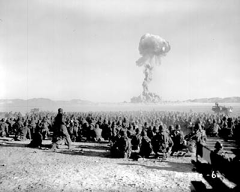
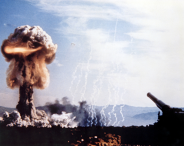
The United States detonates a nuclear shell from a 280mm cannon at the Nevada Test Site, proving that tactical nuclear weapons could be fired from standard artillery pieces. This experiment forces military planners to immediately reconsider battlefield strategies, as it demonstrates that small-scale nuclear strikes were not just theoretical but logistically feasible for frontline troops.
May 25, 1953
73 years ago
Key Figures & Places
United States
Wikipedia
Nevada Test Site
Wikipedia
nuclear testing
Wikipedia
nuclear artillery
Wikipedia

Nuclear weapons testing
Wikipedia

Nevada Test Site
Wikipedia

Upshot–Knothole Grable
Wikipedia

Nuclear artillery
Wikipedia

Las Vegas
Wikipedia

Bomba atómica
Wikipedia

TNT equivalent
Wikipedia

Coordinated Universal Time
Wikipedia

United States
Wikipedia

Operación Upshot-Knothole
Wikipedia

Operación Tumbler-Snapper
Wikipedia

Scopes trial
Wikipedia

Darwinismo
Wikipedia

Charles Darwin
Wikipedia

Philadelphia
Wikipedia

Constitutional Convention (United States)
Wikipedia
National Missing Children's Day
Wikipedia

Disparition d'Etan Patz
Wikipedia

Articles of Confederation
Wikipedia

Constitution of the United States
Wikipedia
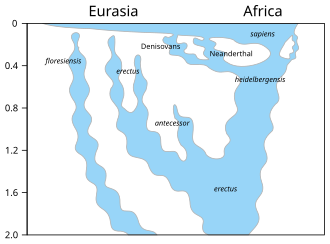
Human evolution
Wikipedia

Tennessee
Wikipedia
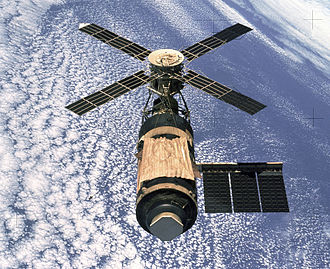
Skylab
Wikipedia

Kennedy Space Center
Wikipedia

Apollo program
Wikipedia

Earth
Wikipedia

John F. Kennedy
Wikipedia
United States Congress
Wikipedia
What Else Happened on May 25
Servius Tullius paraded through Rome to celebrate his decisive military victory over the Etruscans, cementing his authority as the city's sixth king. By formali…
The Chinese saw a broom star sweeping across the sky for two months, bright enough to read by at midnight. They called it a "guest star" and recorded its precis…
Heinrich II. belehnt Boleslaw von Polen mit der (Nieder-)Lausitz und mit dem Milzenerland (der heutigen Oberlausitz). Hierdurch und durch reiche Geschenke Boles…
en Qúrduba (Califato de Córdoba) huye Muhammad al-Mustakfi, quien había sido destituido como califa por los cordobeses.
Alfonso VI of Castile captured Toledo from the Taifa kingdom, shifting the balance of power in the Iberian Peninsula. This conquest transformed the city into a …
Der Steinmetz und Baumeister Erwin von Steinbach beginnt im Auftrag des Bischofs Konrad von Lichtenberg mit dem Bau der Fassade am Straßburger Münster.
Talk to History
Have a conversation with historical figures who witnessed this era. Ask questions, explore perspectives, and bring history to life.